
Mango packing process: from the 25 kg crate to the 10-pound tray
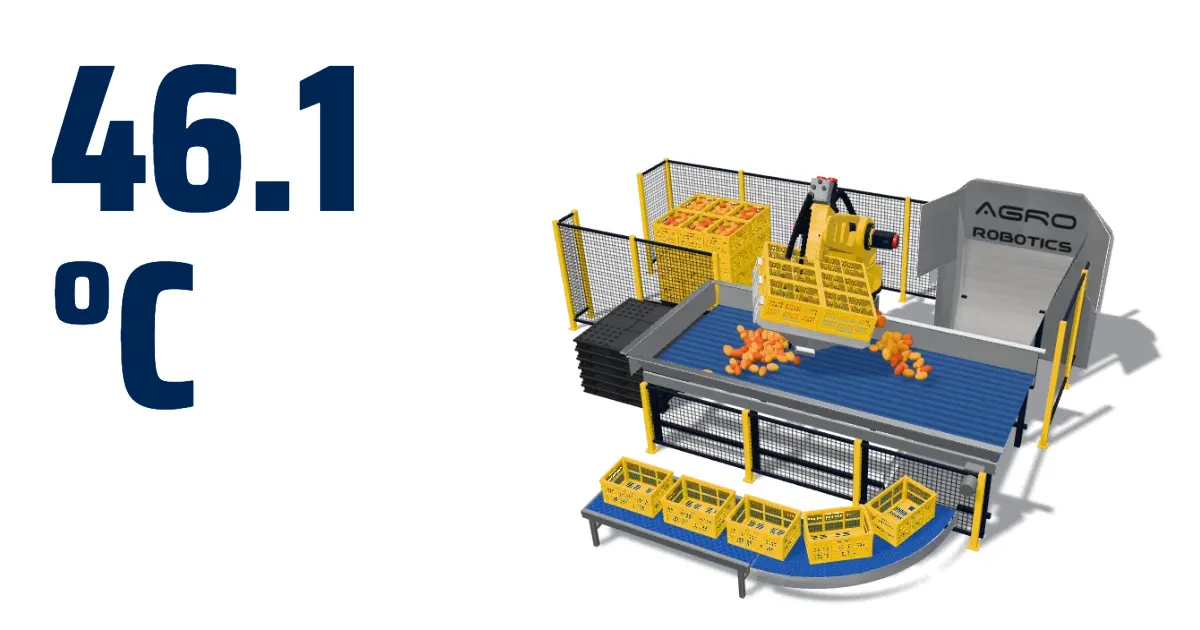
Mangoes arrive in plastic crates of up to 25 kg, get washed, get separated by weight, go into the tank at 46.1 °C for 65 to 110 minutes, get cooled, get graded and leave in a single-layer tray. Whether a robot pays back depends on how many days and shifts your packing floor runs.
Folleto Técnico 37 from INIFAP, Mexico's national agricultural research institute (2019), describes export mango packing in Mexico: a 25 kg field crate, hot water treatment at 46.1 °C for 65 to 110 minutes and baskets of 180 to 200 crates. For Agro Robotics, a Mexican manufacturer of robots for fruit packing houses, the robot question in mango comes down to hours: with a short season at one shift there are few in a year, and the math changes with more shifts or more fruits.
In this article
The basket goes down into the tank with 180 field crates inside, about 20 kg per crate, and stays in water at 46.1 °C for 65 to 110 minutes (INIFAP, Mexico’s national agricultural research institute, Folleto Técnico 37, December 2019). That tank rules the mango packing process for export: before it the fruit gets separated by weight, and after it the fruit has to be cooled on time.
The booklet came out of a survey of 67 questions put to 19 members of EMEX, the Mexican mango export packers’ association, plus fruit packing houses in Guatemala, Ecuador and Peru, and almost all the figures below come from it. Agro Robotics declares mango among its crops (2020 website) and makes a fruit crate tipper for the infeed of the line. Whether it suits you is further down, with the math in view.
The mango packing process, station by station
| Station | Figure in the booklet | Shop-floor detail |
|---|---|---|
| Harvest | Plastic crate with a capacity of 25 kg | Without overfilling, because the crate on top crushes the one below. It is said that each hour in the sun takes a day off shelf life |
| Trip | Dual-wheel truck, 250 to 300 crates; tractor-trailer, up to 1,000 | At most 36 h from harvest to the packing house, under a tarp that lets air through |
| Receiving | Less than 4 h to unload | Truck in the shade and with the tarp already off |
| Washing | 200 ppm of chlorine at the start; water change every 600 crates | By 600 crates the chlorine has already dropped to 10 ppm, and some wash 3,000 with the same water |
| Hot water treatment | 46.1 °C, for 65 to 110 minutes | Water between 115.4 and 116.5 °F; above that, firmness and shelf life suffer |
| Hydrocooling | 21.1 °C, at least 30 minutes | Free chlorine at 20 to 50 ppm and a water change at least every week |
| Rest | 12 to 24 h for 76% of those surveyed | The booklet suggests dropping it if there is no suspicion of sunken shoulders |
| Grading and packing | Automatic by size and color, or by hand | The survey found both cases |
| Cold room | At least 8 h, or 3 h in a forced-air tunnel | 52% of those surveyed work at 10 °C or less, and that is where chilling injury appears |
From the office it is hard to see how much water and how much time go by before the first packed box. In most cases, the fruit arrives and gets washed on the day of harvest and goes into the tank the next day (INIFAP, 2019).
How much does a mango crate weigh in the orchard?
The capacity is 25 kg and the tank works with about 20 kg per crate (INIFAP, 2019). Those 5 kg change two calculations.
The first one is legal. NOM-036-1-STPS-2018, Mexico’s manual handling standard, sets 25 kg per lift for men aged 18 to 45 and 20 kg for women of that age (DOF, Mexico’s official federal gazette, 2018), so a crate filled to the top is out of bounds for a good part of a crew.
The second one is accumulated mass: 10,000 kg per workday if the load is carried less than 10 meters (DOF, 2018). That is 500 crates of 20 kg or 400 of 25 kg per person (Agro Robotics calculation). The booklet says 600 crates is the normal capacity of the truck that comes down from the orchard, meaning 12 to 15 metric tons at those weights (same calculation). A single truck of 600 crates already exceeds what one person can move in a workday.
Count how many times the same crate gets lifted on your packing floor: off the truck, washing, up into the basket, dumping. The comparison with bins and gondolas is in how many kilos a fruit bin holds, and the caps by age and sex are in NOM-036 in fruit packing houses.
How long do mangoes stay in the hot water tank?
It depends on the shape and the weight of the fruit. This is USDA APHIS treatment schedule T102-a for Mexico and Central America, as it stood in the Federal Register of January and May 2003:
| Shape | Examples | Weight per piece | Minutes at 115 °F |
|---|---|---|---|
| Flat or elongated | Ataulfo, Manila, Carabao | Up to 375 g | 65 |
| Flat or elongated | Ataulfo, Manila, Carabao | 375 to 570 g | 75 |
| Rounded | Tommy Atkins, Kent, Keitt | Up to 500 g | 75 |
| Rounded | Tommy Atkins, Kent, Keitt | 500 to 700 g | 90 |
| Rounded | Tommy Atkins, Kent, Keitt | 701 to 900 g | 110 |
APHIS revised the schedule in 2015 for oversized fruit of 651 to 900 g (Federal Register, August 4, 2015), so the times in force get confirmed with its officer at your plant. If you hydrocool within 30 minutes of pulling the basket out, the treatment goes up 10 minutes (USDA, 2003).
Here is the detail that organizes the packing floor. USDA required separating the fruit by weight class and prohibited treating mixed loads (Federal Register, 2003), and the INIFAP booklet gives Ataulfo at 250 to 300 g, Tommy Atkins at 450 to 700 g and Keitt at up to 1,100 g. The scale before the water matters as much as the thermometer inside it.
The water gets counted too. The booklet suggests changing it every 14 baskets: 14 times 180 crates times 20 kg is about 50 metric tons (Agro Robotics calculation). In the survey, 32% changed it every 2 to 3 days and another 32% every 6 to 7 days, and the author recommends keeping count by baskets instead of by days.
The 10-pound tray: what comes out the other end
At the outfeed, mangoes go in a single-layer tray. USDA recorded it in 1992 as a Mexican lug of 10 to 11 pounds, 4.5 to 5 kg (Handbook 697), and its market report still quotes mango in “flats 1 layer”, by count from 6s to 12s (USDA AMS, Los Angeles, November 3, 2026).
A Cal Poly study for the National Mango Board (2013) treats it as a 4 kg tray and describes the shop-floor problem: with 5 large fruit it falls short of 4 kg, and with 12 to 18 small ones it comes close to 5. With the EMEX figures as of June 30, 2026, 45 million boxes and a little over 200,000 metric tons, the average comes to 4.44 kg per box (Portal Frutícola, July 9, 2026; Agro Robotics calculation).
Few pieces per tray change the placing work: the robot finishes each tray very quickly and changes trays very often. Agro does not publish a test with mango. In mango, the heavy load is at the infeed; placing a few pieces per tray is less of a squeeze.
Mango is also on the FDA traceability list (current as of July 24, 2026): whoever does the initial packing assigns the lot code, and the agency will not enforce the rule before July 20, 2028.
Does a robot pay back in a short season?
It depends on how many hours the machine runs in a year, and your days and your shifts decide that. The payback calculator runs the math with your numbers.
The national season runs from January to September in 8 states (EMEX, accessed November 4, 2026) and keeps moving toward the north of Sinaloa (Portal Frutícola, July 9, 2026), so each region sees only one stretch. At two shifts, the same machine runs twice the hours in that stretch. The investment is the same in both cases, and a robot pays back with the hours of heavy lifting it takes off the crew. With few hours a year, review the options that do not call for a robot as well.
What stays on the table:
- Keep dumping by hand and rotate people, so nobody goes over the 10,000 kg per workday in NOM-036.
- Put simple mechanical equipment at the infeed, if your problem is the load and the volume is moderate.
- Add days with another fruit on the same packing floor, because that is where the hour count moves the most.
- Run two shifts at peak, with the overtime of the new workweek in hand, as explained in the 40-hour workweek in fruit packing houses.
If your season is long or you already run two shifts, then a crate tipper is worth a look. The other ways out for the peak are in labor shortage in fruit packing houses.
What to write down this season before asking for a quote
Six lines on a sheet of paper are enough:
- Crates per day in your highest week and in your lowest.
- Weight of 20 full crates on the scale, because 20 and 25 kg give different numbers.
- How many times the same crate gets lifted.
- Weight classes you run and minutes per basket.
- People per shift on loading and unloading.
- Count per tray for each week.
With the crates per day, the boxes per minute tool gives you the rate the infeed has to hold. Write down the year too: EMEX stood at 45 million boxes as of June 30, 2026, more than 12% below a year earlier (Portal Frutícola, July 9, 2026).
Frequently asked questions
What are the steps to pack mangoes for export?
Why do my mangoes get sunken shoulders after the tank?
How often do I change the water in the hot water tank?
Can I store mangoes below 10 °C?
Is a robot worth it if I only pack mangoes at one shift?
Sources
- Osuna García, INIFAP, best practices for packing mango for export, Folleto Técnico 37, Dec 2019 (in Spanish)
- USDA APHIS, Hot Water Dip Treatment for Mangoes, proposed rule, Federal Register, Jan 2, 2003
- USDA APHIS, Hot Water Dip Treatment for Mangoes, final rule, Federal Register, May 23, 2003
- USDA APHIS, revision of treatment schedule T102-a, Federal Register, Aug 4, 2015
- USDA ERS, Weights, Measures, and Conversion Factors, Handbook 697, 1992
- Singh and Saha, Cal Poly, packaging study for the National Mango Board, 2013 (in Spanish)
- USDA AMS, Los Angeles Terminal Market Fruit Prices, Nov 3, 2026 (the link shows the report of the day)
- Portal Frutícola, EMEX figures as of Jun 30, 2026, Jul 9, 2026 (in Spanish)
- EMEX, Empacadoras de Mango de Exportación, website accessed Nov 4, 2026 (in Spanish)
- FDA, Food Traceability List, current as of Jul 24, 2026
- FDA, FSMA 204 traceability rule, accessed Nov 4, 2026
- STPS, NOM-036-1-STPS-2018, manual handling of loads, DOF, Nov 23, 2018 (in Spanish)