
Robots that empty crates and pack fruit in your packing house
One cell at the start of your line and another at the end. The middle stays as it is.
Request a quote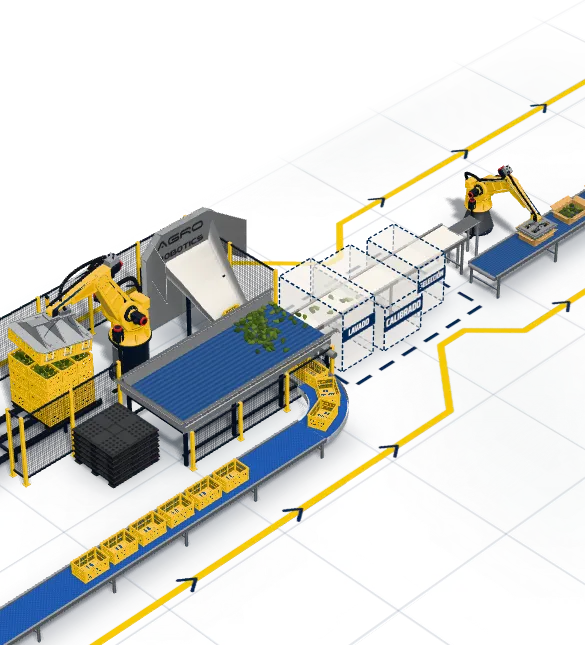
Illustrative demonstration. Your cell comes from your layout.
Agro Robotics is a Mexican manufacturer of robots that empty field crates and pack fruit for packing houses. It applies fruit packing automation to the two ends of the line: its fruit crate tipper takes the full layer of plastic crates off the pallet and empties it onto the belt; its robotic case packer places the fruit in cardboard or plastic boxes.
It builds in Cerro de San Pedro, San Luis Potosí, belongs to Target Robotics Group and sells only in Mexico. On the floor in Mexico you will also hear vaciador for the tipper and encajillador for the case packer. They are the same machines.
Heavy at the start.
Repetitive at the end.
Dumping by hand means lifting crates of 25 kg, right at the limit NOM-036, Mexico's manual handling standard, sets for a man aged 18 to 45, with 10,000 kg accumulated per workday. A line running 5 t/h ties up at least 4 people per shift on dumping alone. NOM-036-1-STPS-2018, from STPS, the labor ministry, in the DOF, Mexico's official gazette, November 23, 2018. Agro Robotics calculation: kg per hour × 8 ÷ 10,000.
That is also where fruit takes its hits: in four avocado packing houses, INIFAP, Mexico's national agricultural research institute, measured the hardest impacts on the dumping belt, and slowing it down did not reduce them. The damage shows only once the avocado ripens, by then at your customer's. INIFAP, measured in 2012, published in 2017. Fruit crate dumping guide.
Packing weighs less and wears people out just the same: thousands of pieces a day, in the pack pattern each customer wants. Starting in 2027 the legal workweek drops to 46 hours, and by 2030 it reaches 40, with no pay cuts. Reform to Mexico's Federal Labor Law, DOF, May 1, 2026. What it means for an avocado packing house.

Illustrative demonstration. Your cell comes from your layout.
Infeed: the fruit crate tipper empties the pallet onto your belt
An arm takes the full layer of plastic crates, empties it onto the belt and moves the empty crates out. Nobody climbs on the pallet or hauls a crate.
- Takes
- The full layer
- Crate
- Plastic field crateSize and weight get confirmed with yours.
- Rate
- Measured with your crateAnd with what your line can take.
The middle stays untouched
Your washer, grader and sorting tables stay. The cells go at the two ends, and you can start with one.
How the line comes together
Illustrative demonstration. Your cell comes from your layout.
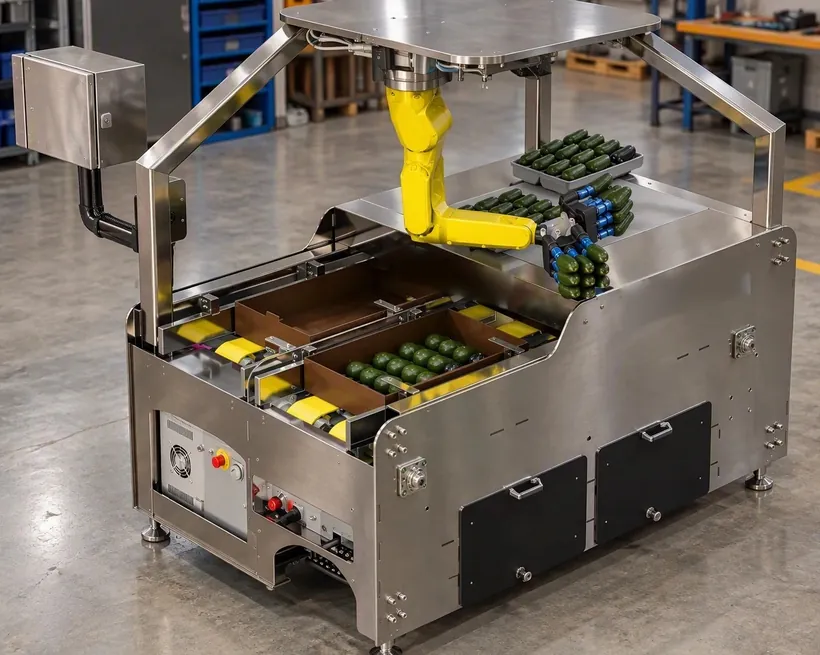
Outfeed: the robotic case packer places fruit in the box
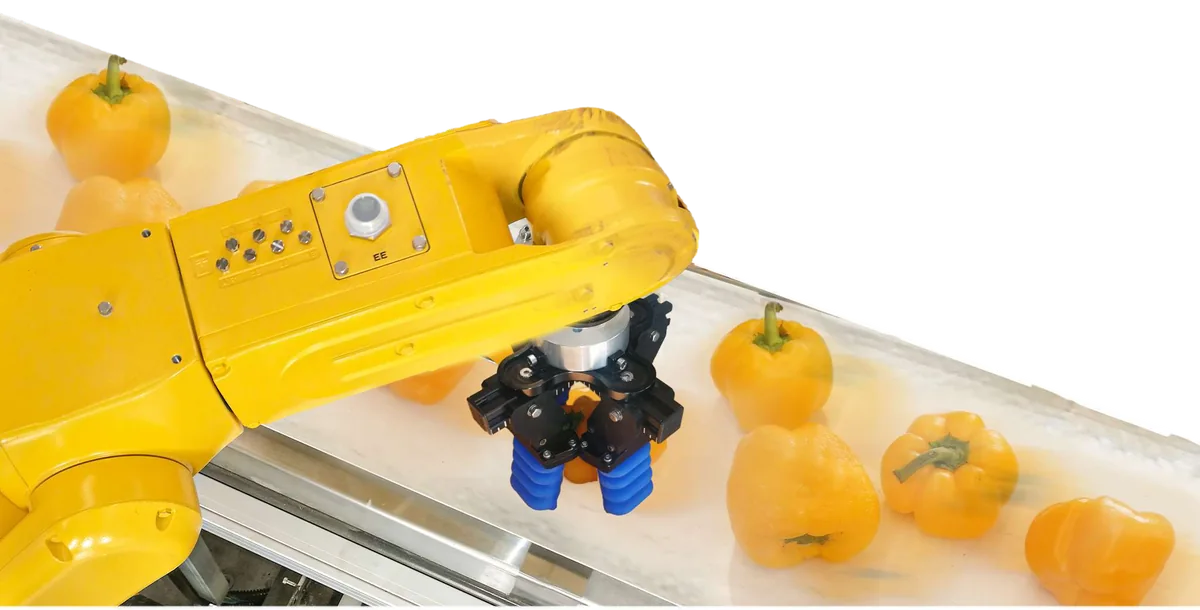
It takes each fruit with a tool suited to your crop and sets it in the box in the pack pattern your customer asks for. For another format, you change the program and the tool.
- Rate
- Measured with your fruitAnd with your size and pack pattern.
- Box
- Cardboard or plastic
- How it gets quoted
- With your fruit and pack patternYou tell us what you pack, in which box and how your customer wants it.

Illustrative demonstration. Your cell comes from your layout.
When does it pay back? It depends on your days and your shifts
A machine that runs 270 days on two shifts pays back much sooner than the same machine in a short season at one shift. So this page gives you no payback promise: you run the math with your own numbers.
540 labor days per year for each position you move off crate dumping or case packing
| Days per year | 1 shift | 2 shifts | 3 shifts |
|---|---|---|---|
| 90 | 90 | 180 | 270 |
| 150 | 150 | 300 | 450 |
| 170 | 170 | 340 | 510 |
| 270 | 270 | 540 | 810 |
The season sets the clock: decide before the fruit catches up with you
A cell goes in during the lightest months of your packing house, and the decision gets made months earlier. Your crop's harvest curve and your own scale tell you which months those are; we look at it with your season.
What happens if it fails mid-harvest?
It is the first thing a packing line manager asks, and with good reason. Three things worth asking before you sign:
- How soon someone reaches your packing house, given your region and your harvest hours.
- Which spare parts stay at your plant and which ship from San Luis Potosí.
- How you keep packing while the failure gets fixed.
What do you pack?
- AvocadoMichoacán and southern Jalisco. Plastic crates on pallets, almost year-round: this is where we start.
- LimeVeracruz, Michoacán and Colima. Crate dumping is the clear fit; the outfeed usually goes by weight.
- Tomato and pepperSan Luis Potosí and the Bajío region, a few hours from the plant. Formats that change often.
- MangoA 25 kg crate and a short season. With few days at one shift, run the numbers before you request a quote.
Grapes or berries? They get packed in the field, and today we have no machine for that. Apple? Tell us how it reaches you: it all depends on the bin machine. A palletizer with no fruit involved? That is Target Robotics (in Spanish), our sister company.
We build, install and service it from San Luis Potosí
Agro Robotics is the Target Robotics Group company dedicated to packing houses. Target has operated since 2001 and makes palletizers; the two share a plant on Camino a la Joyita, in Cerro de San Pedro.
Who we areWorth reading before you request a quote
Ask us what applies to your lineWhat we get asked most
What does a robot do in fruit packing automation?
How many crates per minute does the fruit crate tipper empty?
How much does a robot for my packing house cost?
Does it damage the fruit?
Do I have to change my line or my grader?
What happens to my crew?
Do you sell outside Mexico?
Tell us what you pack and how the fruit reaches you
With that, your crate and your volume, we will tell you which cell makes sense first and what is left to measure.