
Labor shortage in fruit packing houses: your options before a robot
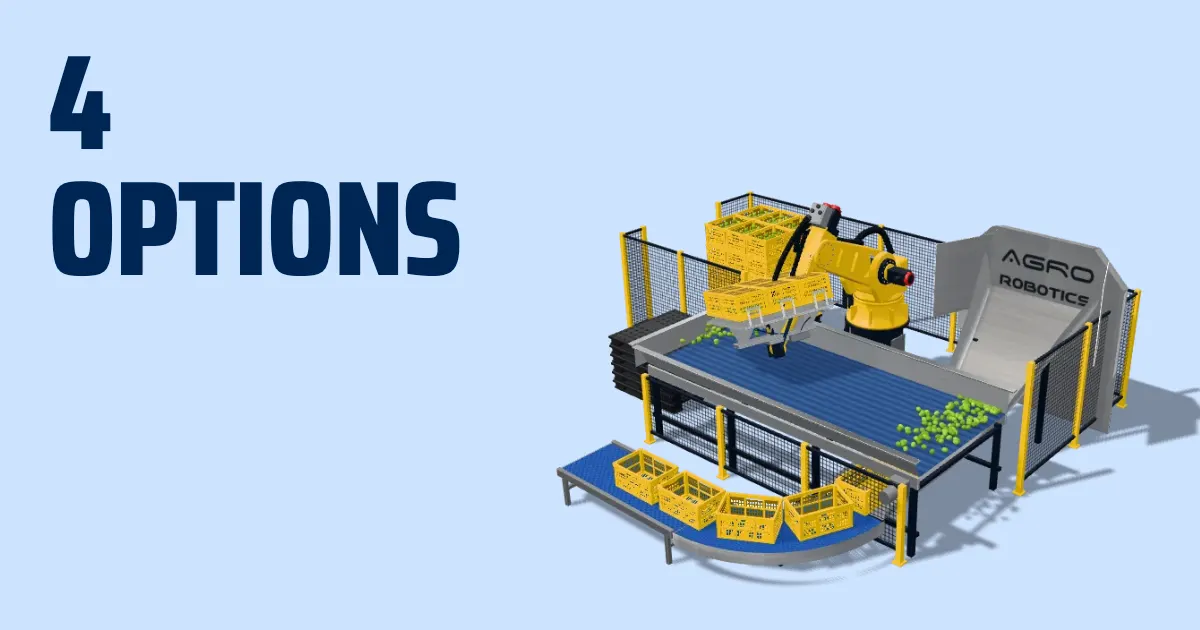
Before a robot there are four ways out: another shift, overtime within its cap, packing tables and mechanical equipment. The robot comes in when the season is long, there are two shifts and the bottleneck is loading or placing fruit; with a short season at one shift, payback stretches out.
In Mexico, as of November 4, 2026, we did not find an official statistic on vacancies in packing houses; the labor shortage in fruit packing houses is known through testimony such as that gathered by Produce Business (2026). Before a robot there are shifts, overtime capped at 9 hours a week at double pay in 2027 (DOF, 2026), tables and mechanical equipment. Agro Robotics recommends running the numbers with your own days and shifts.
In this article
We did not find an official statistic on the labor shortage in fruit packing houses in Mexico. We searched through November 4, 2026, and what exists is industry testimony, without a figure for vacancies by region or for turnover in season. So this text starts with your attendance list and without any national percentage.
Here is what you can try before a robot, how far each option stretches and when the fruit crate tipper or the robotic case packer for fruit is the answer. The legal points cite the LFT, Mexico’s Federal Labor Law (Ley Federal del Trabajo), and this text is not legal advice: a labor lawyer must validate your case.
How serious is the labor shortage in fruit packing houses?
Produce Business gathered in June 2026 two statements from industry executives in Mexico. One said, at the IFPA México conference, that the farm workforce has hovered around 3 million people since 2017-18, that it has aged and that it has other options. Another said there is not enough labor and that this is why their packing houses are moving to more automated lines.
It is testimony, and it has to be read that way. For Chile, a 2026 report from the Universidad de O’Higgins says that those who recruit for packing houses find it harder and harder to fill vacancies. It does not describe Mexico either. Your own list tells you more: how many were absent on the peak Monday and how many never came back after the first two weeks.
Measure first: too few people or too much peak?
Too few people and too much peak feel the same on the packing floor and get solved differently. Two weeks of attendance lists and of kilos per hour tell you which one you have. Work out the rate with boxes per minute.
| What you see | What is usually happening | What to check first |
|---|---|---|
| The line runs at half speed in the morning and gets overwhelmed in the afternoon | The fruit all arrives at the end of the harvest day | Receiving schedule and shift |
| People are missing two or three weeks a year | Short peak | Overtime and seasonal crew |
| The hopper station changes people every week | Heavy lifting | Mechanical equipment, and the limits in NOM-036, Mexico’s manual handling standard |
| The packing table sets the rate | Bottleneck at packing | Tables, stations or filling by weight |
| People are missing all year at every station | A plain shortage of people | Wages, transportation, and after that a machine |
Agro Robotics’ reading; your data decides. If the problem lasts two weeks, a machine that works all year is almost never the first answer.
Another shift or more overtime?
The overtime cap is 9 hours a week at double pay in 2026 and 2027, spread over up to 4 per day and a maximum of 4 days; up to 4 more at triple pay; and never more than 12 hours of regular time and overtime combined in one day (decree in the DOF, Mexico’s official federal gazette, May 1, 2026, arts. 66 and 68). From 2027 those hours are counted from a 46-hour workweek, and they cost more each year, as detailed in 40-hour workweek in fruit packing houses.
| Option | Legal cap | What it asks of you | Where it falls short |
|---|---|---|---|
| Overtime | 9 double-pay and 4 triple-pay hours per person per week in 2027 | A willing crew and a record of every hour | Fatigue, and at the hopper the accumulated mass |
| Second shift | 7 hours if it is a night shift, 7.5 if it is mixed (arts. 60 and 61) | Another crew and another supervisor | If you can no longer find people for one, the second gets complicated |
| Committed seasonal crew | Discontinuous employment relationship, with the same rights in proportion to time worked (art. 39-F) | Giving dates well ahead and keeping conditions steady | It only works if your season repeats |
| Extending the season with another fruit | Without a legal cap of its own | Another format and other customers | Only if your line can handle the other fruit |
The last row comes from Chile: the O’Higgins report says that many packing houses process fruit from different seasons to extend the work and retain their people. In Mexico we did not find data like that, and you can try it if you already have the customer.
The second shift is the option that asks for the most people, right when they are hardest to find. To look for them, an agency can help you recruit, select and train, and you remain the employer (LFT, art. 12).
A packing table or mechanical equipment?
It pays to exhaust this part before you get a quote for a robot. The rates are the ones Mexican manufacturers publish on their spec sheets, accessed on November 4, 2026 and listed in the sources; the reading of when each one fits is Agro Robotics’ own.
| Equipment | Published rate | It fits when | What it leaves unsolved |
|---|---|---|---|
| Manual packing module or table | No rate is published | Your pack pattern is specific and you want to organize stations | You still need someone to place the fruit |
| Weigh filler | From 4 to 5 boxes per minute | Your product goes in bulk and by weight | It does not place piece by piece |
| Torsion crate dumper | From 12 to 15 crates per minute | Crates in a single format, moderate rate | Someone still takes crates off the pallet |
| Linear or rotary crate tipper | 22 linear, up to 36 rotary | High rate and uniform crates | Someone still takes crates off the pallet |
Between a crate tipper and a robot there are differences, explained in crate tipper vs crate dumper. There are also the measures that cost no machine: bringing the pallet closer with a pallet jack, lowering the weight of the field crate and rotating stations, all recognized by NOM-036 (items 8.3 b) 3 and 8.6).
A well-set table shows at the end of the shift: the fruit at the height of the person and the box change without twisting the body. We have no public figure for how much it helps retain people, so ask your crew what weighs on them most.
When is the robot the answer?
When you have already tried the above and the math holds. Agro Robotics’ reading, by situation:
| Your situation | What to read from it |
|---|---|
| Export avocado that runs almost all year, in plastic crates on pallets | It is worth running the numbers |
| Two shifts and the hopper station always short of people | It is worth running the numbers |
| Mango at one shift, with a short season | Few hours a year: compare with tables and mechanical equipment too |
| Fruit in bins or in bulk in a gondola | Today Agro publishes no bin machine: ask first |
| Many formats in the same week | Ask for format changeover minutes before you request a quote |
Agro’s robot takes the full layer of plastic crates off the pallet, and its rate gets measured with your crate: it only counts if your line can take it. For the case packer, a good first step is to read how to start with a first robot and try your days in the payback calculator.
The robot takes away hours of loading and lets you decide where to move the people you already have. For those people, the plan is in automating a fruit packing house without layoffs. The two-week peak on a line that has capacity to spare the rest of the year stays the same.
Three numbers before you call anyone
Kilos per hour at peak, hours per person per week and season days. With those three you know whether your problem is people, schedule or load, and any supplier can answer you with figures.
Frequently asked questions
What do I do if I cannot find people for packing in season?
How much overtime can I ask of my people?
Can I cover the peak with a staffing company?
Does a robot solve my shortage of people?
Sources
- Produce Business, in Perishable News, automation in Mexico, June 3, 2026
- Universidad de O'Higgins (Chile), occupations report, agricultural packing house packer, 2026 (in Spanish)
- Decree reforming the Ley Federal del Trabajo on the reduction of the workweek, DOF, May 1, 2026 (in Spanish)
- Cámara de Diputados, Ley Federal del Trabajo, arts. 12 to 15, 39-F, 60, 61 and 66 to 68, last amended DOF May 14, 2026 (in Spanish)
- STPS, NOM-036-1-STPS-2018, DOF, November 23, 2018 (in Spanish)
- Spec sheet for a manual packing module, Industrias Rochín, accessed November 4, 2026 (in Spanish)
- Spec sheet for a weigh filler, up to 5 boxes per minute, Packett, accessed November 4, 2026 (in Spanish)
- Spec sheet for a weigh filler, 4 boxes per minute, Industrias Rochín, accessed November 4, 2026 (in Spanish)
- Spec sheet for a torsion crate dumper, 12 to 15 crates per minute, Industrias Rochín, accessed November 4, 2026 (in Spanish)
- Spec sheet for a crate tipper, 22 linear and up to 36 rotary, Zaizer, accessed November 4, 2026 (in Spanish)