
Automating tomato and pepper packing: gondola, formats and format changeovers
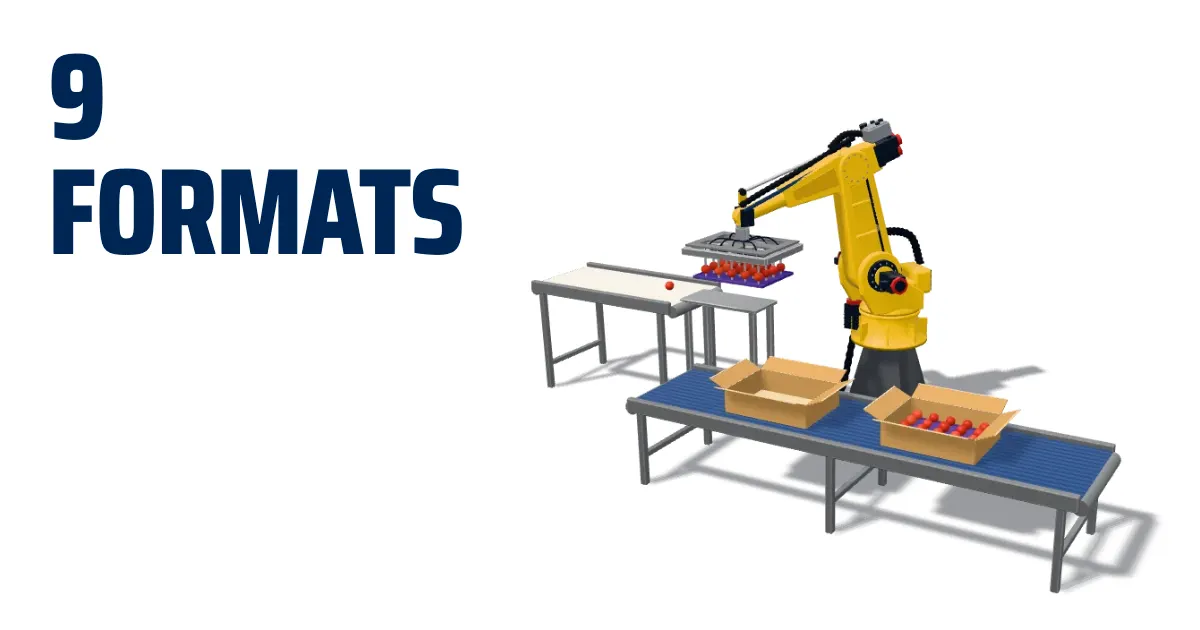
You automate it in parts: first the infeed if you receive in plastic crates, then the outfeed that ties up the most people. Before you ask for a quote, bring your list of formats and how many times you change over per shift, because that time defines whether the robot works or waits.
To automate tomato and pepper packing in Mexico, Agro Robotics recommends starting by counting formats: USDA quoted nine from Mexico on November 4, 2026, from 25 lb loose to flats of 12 clamshells. Tomatoes and bell peppers are on the FDA traceability list (2026), with a lot code from the initial packing on, and the agency will not enforce the rule before July 20, 2028.
In this article
The USDA report for the Atlanta market of November 4, 2026 carried nine formats from Mexico between tomatoes and bell peppers. Before automating tomato and pepper packing, that list weighs more than the speed of the robot, because each line item changes the box and the pack pattern, and sometimes even the label.
Money is tight too. USDA FAS sees tomato exports falling to 1.8 million metric tons in 2026, with a 17% antidumping duty in the United States, and San Luis Potosí contributed 11% of 2025 production (report of June 2, 2026). A purchase like this has to survive a bad season, and Agro Robotics proposes going in parts: the fruit crate tipper at the infeed and the robotic case packer for fruit at one outfeed, without buying a complete line.
Before automating tomato and pepper packing
Draw your line and mark which stations carry load and which ones have changeovers. The CIAD and SENASICA manual (2002) includes the diagram for green tomato: metal or fiberglass gondola, inspection, dumping or unloading by water flume, washing, drying, waxing, inspection, sorting, grading by size and color, packing, palletizing, ripening and cooling.
Of that list, Agro handles the two ends. The useful question is which of the two hurts you more today, because it rarely pays to start with both.
For bell peppers, that manual has no diagram of its own, and we found no other public one for Mexico either. Draw yours on a sheet of paper before you ask for a quote.
How does fruit arrive: gondola, batanga or plastic crate?
Gondola. Unloading usually goes with water, and there temperature rules: with a 10 °F difference between pulp and water, tomatoes tend to take in water, and the manual recommends heating the tank (CIAD and SENASICA, 2010). With a batanga, the field trailer, the same manual asks that whoever unloads it stay outside, with mobile ladders around it. Agro publishes no machine today for emptying a gondola or a bin.
Plastic crate. Here there is a robot, and the first check is weight. These are capacities published by a Mexican manufacturer (DM Plast, accessed November 4, 2026), against the cap of 25 kg per lift that NOM-036-1-STPS-2018, Mexico’s manual handling standard, sets for men aged 18 to 45 (DOF, Mexico’s official federal gazette, 2018):
| Crate | Capacity | Dimensions | Against the 25 kg cap |
|---|---|---|---|
| María | 35 kg | 56 x 37 x 33 cm | 10 kg over, full |
| Colima | 30 kg | 55.5 x 38 x 33 cm | 5 kg over, full |
| Andrea | 30 kg | 52.2 x 34 x 30.3 cm | 5 kg over; stacks up to 8 with product |
| Chapala | 25 kg | 52.5 x 35 x 41 cm | Right at the cap; stacks up to 8 |
| Tijuana | 20 kg | 50 x 32.6 x 27.5 cm | Within it, and also within the 20 kg cap for women |
A full crate that goes over 25 kg no longer fits in the math for one person alone. With the robot there is another check: the full layer of 35 kg crates weighs much more than with a 25 kg crate, so robot and tool get confirmed with your full crate.
What formats come off a tomato and bell pepper line?
These are the nine from the USDA AMS report of November 4, 2026, ordered by what they ask of a machine. The weights in pounds come from the report itself, except where noted.
| Crop | Format in the report | Weight | What it asks of the machine |
|---|---|---|---|
| Tomato, round and Roma | 25 lb loose | 11.34 kg | Fill by weight |
| Grape tomato | 20 lb loose | 9.07 kg | Fill by weight |
| Grape tomato | 10 lb loose | 4.54 kg | Fill by weight |
| Round tomato | 2-layer box | 9.1 kg (USDA, Handbook 697, 1992) | Place by size |
| Tomato on the vine, greenhouse | 5 kg/11 lb tray | 5 kg | Pick up the whole cluster |
| Grape and cherry tomato | Flat of 12 pints with lids | 12 clamshells | Fill and then case pack |
| Bell pepper | 25 lb box | 11.34 kg | Fill or place, depending on the customer |
| Bell pepper | 1 1/9 bushel box | 12.7 kg (USDA, Handbook 697, 1992) | Fill or place, depending on the customer |
| Bell pepper, greenhouse | 5 kg/11 lb box | 5 kg | Place by color and size |
Careful with the names. In tomatoes, 5x6 or 6x6 used to say how many pieces fit across and along the box; today it names the size of the fruit and no longer how it comes packed (US Foods, accessed November 4, 2026).
Each group of rows calls for a different machine: a pick and place robot, a bulk filler or a weigher. The differences are in what is a fruit case packer. Agro declares tomato and bell pepper among its crops (2020 website) and, for the case packer, a corrugated or plastic box (2021 presentation). What is public so far is demonstrations, so ask to see it with your fruit before you decide. The format that runs the most hours a month is the one that pays for the machine, even if another one is the showiest.
Can a robot fill grape tomato clamshells?
Filling and case packing are two different jobs. First someone fills the clamshell by weight; then 12 clamshells go into a flat.
For the first job, dedicated fillers are used. TOMRA publishes for its CURO up to 160 clamshells per minute, from 125 g to 5 kg, and mentions tomato among the fruits (accessed November 4, 2026). Agro publishes no machine today for filling clamshells: its case packer works with a cardboard or plastic box. If your line is almost all clamshell, get a quote for the filler first and then talk through what happens with the full flats.
How many minutes does a format changeover take?
Almost nobody publishes it. The reference we found is that same filler: under five minutes, without tools (TOMRA, accessed November 4, 2026), for its machine and its container. Agro does not publish that time either: ask about it when you request a quote.
Why the stopwatch is worth it: with 6 changeovers per shift of 15 minutes each, that is 90 of 480 minutes, 19% of the shift without packing at that outfeed (Agro Robotics calculation with those assumptions). At 2 changeovers of 5 minutes, it is 10 minutes. A format changeover that nobody times gets paid for every day and never shows up in the quote.
What it pays to ask at the demonstration:
- From the last good one to the first good one, on the stopwatch, how many minutes?
- What gets changed besides the program: gripper, guides, box erector, label?
- Does your operator do it or does it take a technician? With what tool?
- How many recipes does it store, and who sets up a new format?
- What happens to the fruit that is already on its way during the changeover?
- Will you show it to me with my box and my fruit?
With your boxes per shift, the boxes per minute tool tells you what rate you would lose at each stoppage.
The lot label gets automated too
Fresh tomatoes and bell peppers are on the FDA traceability list, and avocado stays off it (list current as of July 24, 2026). Whoever does the initial packing assigns the traceability lot code, and the records must be available within 24 hours if the agency asks for them. By order of Congress, the FDA will not enforce the rule before July 20, 2028 (FDA, accessed November 4, 2026). Confirm with your importer what it asks of you starting today.
In Mexico, the CIAD and SENASICA manual already asked that each stack carry grower, product, variety, packing date and shipping time, tied to the lot and to the field block.
This touches the robot at one fine point. If the recipe changes to another format and the printer keeps running the previous label, you have well-packed boxes with the wrong lot. Ask that the recipe change also change the label, or that the outfeed stop until the label is confirmed.
Send whoever is going to quote you the list of formats from the last month, the changeovers in your worst shift and a photo of the box with its label.
Frequently asked questions
Where do I start if I want robots in my tomato packing house?
Can one person dump a 35 kg tomato crate alone?
Is a robot any use to me if I change formats several times a day?
Do my tomatoes need a lot code for the United States?
Sources
- USDA AMS, Atlanta Terminal Market Vegetables Prices, Nov 4, 2026 (the link shows the report of the day)
- USDA ERS, Weights, Measures, and Conversion Factors, Handbook 697, 1992
- CIAD and SENASICA, Manual de Buenas Prácticas Agrícolas, 2002 (in Spanish)
- DM Plast, tomato crates, accessed Nov 4, 2026 (in Spanish)
- STPS, NOM-036-1-STPS-2018, manual handling of loads, DOF, Nov 23, 2018 (in Spanish)
- USDA FAS, Tomatoes and Products Annual, Mexico, MX2026-0028, Jun 2, 2026 (copy on APEDA)
- US Foods, tomato guide, accessed Nov 4, 2026
- TOMRA, CURO filler, accessed Nov 4, 2026
- FDA, Food Traceability List, current as of Jul 24, 2026
- FDA, FSMA 204 traceability rule, accessed Nov 4, 2026