
How many kilos a fruit bin holds, a field crate and a gondola
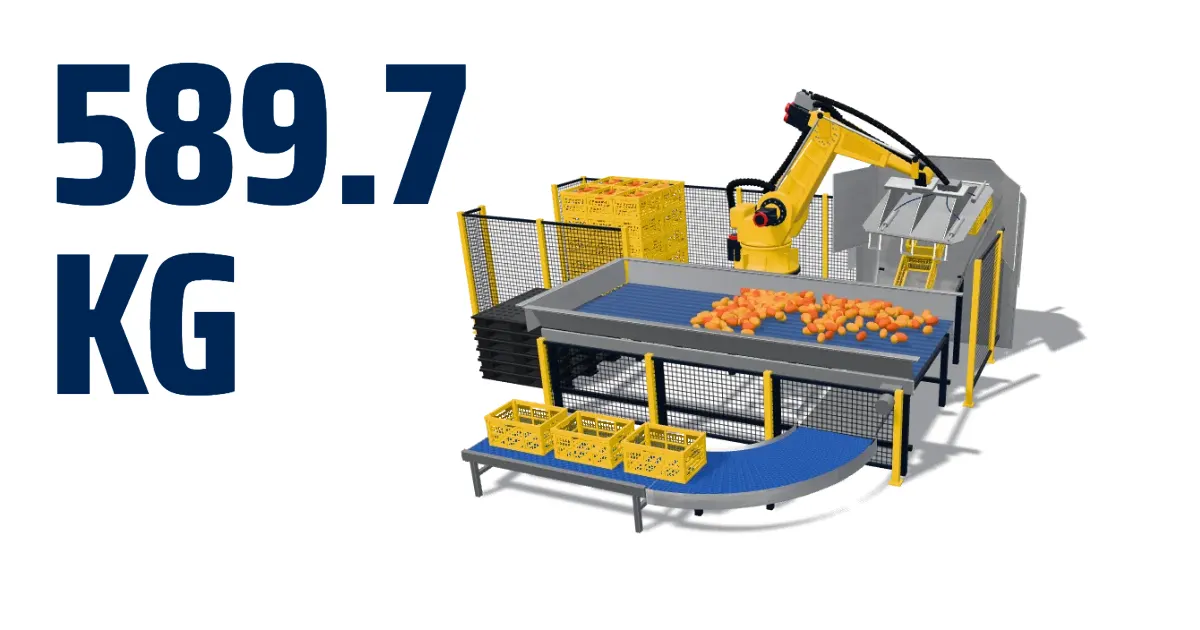
A 919-liter plastic bin takes up to 590 kg and holds 473 to 568 kg of apples, by our calculation. A field crate runs between 20 and 35 kg, depending on crop and model. For the gondola we found no public figure: you have to weigh it.
In Mexico, a 919-liter MacroBin 34-FV plastic bin carries up to 589.7 kg (Macro Plastics spec sheet, checked in 2026), and Agro Robotics calculates 473 to 568 kg of apples with the USDA bushel (1992). The mango crate has a 25 kg capacity (INIFAP, 2019), the avocado crate weighs 25 kg (Agro, 2024) and the tomato crate reaches 35 kg (DM Plast, 2026).
In this article
Multiply liters by what the loose fruit weighs and you know how many kilos a fruit bin holds. USDA gives 40 to 48 pounds per bushel of apples (Handbook 697, 1992), which is 0.51 to 0.62 kg per liter. A 919-liter MacroBin 34-FV then holds 473 to 568 kg (Agro Robotics calculation), close to the 589.7 kg its spec sheet marks as maximum load.
That math works for apples. For other fruit, weigh a full bin and subtract the tare. That number decides what serves you at the infeed of the line: a fruit crate tipper, a bin dumper or unloading with water.
How many kilos a fruit bin holds, by size
Dimensions, load and tare from the Macro Plastics spec sheets published by its distributor in Mexico, Groways (checked on November 4, 2026). The last column is an Agro Robotics calculation, with 40 and 48 pounds per bushel of apples.
| Bin | Outside dimensions | Liters | Maximum load | Tare | Apples, calculated |
|---|---|---|---|---|---|
| MacroBin 16-FV | 119.7 x 119.7 x 54.6 cm | 454 | 544.3 kg | 35.6 kg | 234 to 280 kg |
| MacroBin 24-FV | 119.7 x 119.7 x 71.4 cm | 667 | 544.3 kg | 40.6 kg | 343 to 412 kg |
| MacroBin 32-FV | 113.7 x 122.6 x 75.9 cm | 770 | 589.7 kg | 38.8 to 41.5 kg | 397 to 476 kg |
| MacroBin 34-FV | 113.7 x 122.6 x 87.9 cm | 919 | 589.7 kg | 43.1 to 45.8 kg | 473 to 568 kg |
| ShuttleBin 330 | 101.6 x 121.9 x 83.8 cm | 770 | 680.4 kg | 49 to 49.9 kg | 397 to 476 kg |
Two details from those spec sheets will slip your mind unless you write them down. The 16-FV is lower and the manufacturer recommends it for delicate fruit and vegetables. And stacking has two limits: up to 8 units, but also 3,855.5 kg of stacked weight over the long term at ambient temperature. With 613 kg per full bin, fruit plus tare, you get 6 high in storage (Agro Robotics calculation). The spec sheet says how many bins fit in height; your fruit decides how many they can bear.
If you use wooden bins, weigh them often: according to the same manufacturer, wood absorbs water, and the tare moves with it.
How much does a field crate weigh, by crop?
Here capacity and full weight look alike, which makes them easy to confuse.
| Crop | Container | Weight or capacity | Source |
|---|---|---|---|
| Mango | Plastic crate | 25 kg capacity; about 20 kg in the hot water treatment tank | INIFAP, 2019 |
| Tomato | María crate, 56 x 37 x 33 cm | 35 kg capacity | DM Plast, 2026 |
| Tomato | Colima crate, 55.5 x 38 x 33 cm | 30 kg capacity | DM Plast, 2026 |
| Tomato | Tijuana crate, 50 x 32.6 x 27.5 cm | 20 kg capacity | DM Plast, 2026 |
| Apple, already packed | One-bushel box or basket | 18.1 kg | USDA, Handbook 697, 1992 |
For bell pepper we found no public figure for a field crate. Weigh it.
Against that table stands NOM-036-1-STPS-2018, Mexico’s manual handling standard: 25 kg per lift for men aged 18 to 45, 20 kg for women of that age and 10,000 kg of accumulated mass per workday if the load is carried less than 10 meters (DOF, Mexico’s official federal gazette, 2018). That is 400 crates of 25 kg per person (Agro Robotics calculation). The mango bulletin from INIFAP, Mexico’s national agricultural research institute, also asks you to avoid overfilling, because the crate on top compresses the one below. The full process is in the mango packing process.
The gondola: a number we did not find published
The manual by CIAD, a Mexican food research center, and SENASICA, Mexico’s agricultural health and food safety agency (2002), describes tomatoes arriving in gondolas of metal or fiberglass, unloaded by water flume, and batangas (farm trailers) that get emptied with mobile ladders set around them. It gives no kilos, and we found no Mexican public source with the weight of a gondola of fresh-market tomatoes.
If your load goes over a truck scale, you already have the number: weight in minus weight out, over several loads. Write down the unloading time too, because that time tells you the rate the tank has to keep up with.
How many crates or bins fit on a truck?
For crates, the clearest public figure is for mango (INIFAP, Folleto Técnico 37, 2019). The metric tons are an Agro Robotics calculation.
| Vehicle | Crates | At 20 kg per crate | At 25 kg per crate |
|---|---|---|---|
| Pickup truck with dual rear wheels | 250 to 300 | 5 to 6 t | 6.3 to 7.5 t |
| Regular orchard truck | 600 | 12 t | 15 t |
| Tractor-trailer | Up to 1,000 | 20 t | 25 t |
The other limit is legal. NOM-012-SCT-2-2017, Mexico’s standard for truck weights and dimensions (DOF, Dec 26, 2017), sets the gross vehicle weight by road type, vehicle and load included:
| Vehicle | ET and A roads | B road | C road |
|---|---|---|---|
| C2, 6 tires | 19 t | 16.5 t | 14.5 t |
| C3, 10 tires | 27.5 t | 23 t | 20 t |
| T3-S2 | 46.5 t | 38 t | 33.5 t |
Now with bins. The same standard sets a maximum width of 2.60 m and requires a caution sign on semitrailers longer than 14.63 m (48 feet). In those 14.63 m, a MacroBin 34-FV of 113.7 x 122.6 cm fits 2 across and 12 along if the deck gives 2.46 m usable: 24 per level and 48 bins on two levels (Agro Robotics calculation). At 613 kg each that is 29.4 t, and if tractor and trailer weigh 16 t, an assumption you should confirm with your carrier, the total comes to 45.4 t. It passes on ET and A roads. On a B road, 22 t are left for the load, about 35 bins, and on a C road, about 28. On a type B road, the weight limit runs out before the deck space does.
Why does weight matter when you choose a machine?
Because the same rate looks very different. At 5 t/h (metric tons per hour) that is 200 crates of 25 kg per hour, one every 18 seconds, or about 10 bins of 520 kg per hour, one every 6 minutes (Agro Robotics calculation). With crates, the problem is backs and pace; with bins, it is forklifts and impact.
Different questions come out of that:
- Crates on a pallet. Agro published its crate tipper for plastic crates on pallets (Instagram, February 2024). The question is whether your layer and your crate fit.
- Bin. Today Agro publishes no machine for dumping bins. Its 2021 presentation does include a presorter that works with bins, which appears in other fruit packing house machines; what bin weight it accepts gets confirmed with yours.
- Gondola. Unloading with water cushions the impact another way, and the question becomes the temperature of the tank (CIAD and SENASICA, 2002).
For the vocabulary and the types of equipment, continue with crate tipper vs crate dumper; to turn your metric tons into crates, with the boxes per minute tool. The part about impact is in the fruit crate dumping guide.
Before you ask for a quote, weigh 10 full containers from your highest week and write down the tare. With that sheet, the quote starts from your crate.
Frequently asked questions
How much does a full apple bin weigh?
How many 25 kg crates can one person move per shift?
How much does a gondola of tomatoes weigh?
Does the Agro crate tipper work for bins?
Sources
- Groways, bin distributor in Mexico, dimensions and volume, checked Nov 4, 2026 (in Spanish)
- Macro Plastics, MacroBin 32 and 34 spec sheet, on the Groways site, checked Nov 4, 2026
- Macro Plastics, MacroBin 16 and 24 spec sheet, 2014, on the Groways site
- Macro Plastics, ShuttleBin 330 spec sheet, on the Groways site, checked Nov 4, 2026
- USDA ERS, Weights, Measures, and Conversion Factors, Handbook 697, 1992
- Osuna García, INIFAP, best practices for packing mango for export, Folleto Técnico 37, Dec 2019 (in Spanish)
- DM Plast, tomato crates, checked Nov 4, 2026 (in Spanish)
- CIAD and SENASICA, Manual de Buenas Prácticas Agrícolas, 2002 (in Spanish)
- SCT, NOM-012-SCT-2-2017, maximum weight and dimensions, DOF, Dec 26, 2017 (in Spanish)
- STPS, NOM-036-1-STPS-2018, manual handling of loads, DOF, Nov 23, 2018 (in Spanish)
- Agro Robotics, Instagram post about the dumping robot, Feb 24, 2024 (in Spanish)