
Fruit crate tipper for packing houses in Mexico
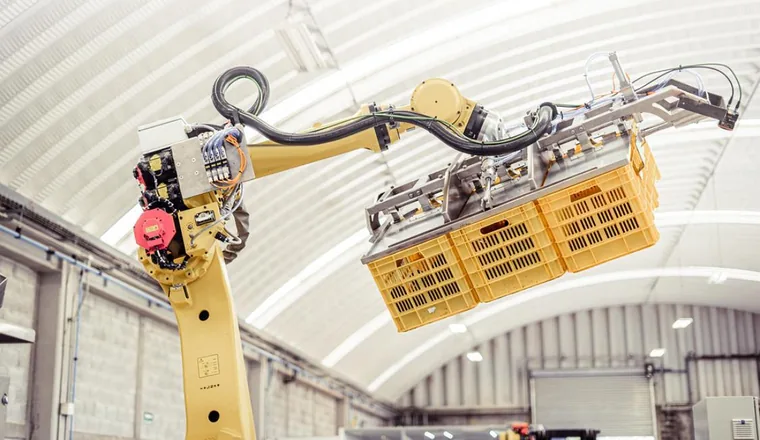
A robot takes a full layer of plastic crates off the pallet, empties it onto your belt and moves the empties out. Inside the company we call it vaciador; you will also see it as volteadora or volcador de cajas.

Illustrative demonstration. Your cell comes from your layout.
How many crates per minute does the fruit crate tipper empty?
The Agro Robotics fruit crate tipper takes the full layer of plastic crates off the pallet and empties it onto the belt. How many crates per minute it empties in your packing house gets measured with your crate and your fruit, and depends on what your line can take. It is built in Cerro de San Pedro, San Luis Potosí, and sold only in Mexico.
- Takes
- The full layer off the palletCrates per layer and their weight get confirmed with your crate.
- Rate
- Measured with your crate and your fruitAnd set by what your grader can take.
- Crate
- Plastic field crateWhether your crate and your layer fit gets confirmed with yours, full.
Four moves, and nobody climbs on the pallet
The pallet arrives
A forklift or conveyor sets it at the pick point. You keep receiving the way you do today.
It takes the full layer
The tool takes the top crates in one go. Nobody breaks down the pallet by hand.
It turns the layer over the belt
It empties the layer close to the belt. How much drop height is left gets measured on your line, with your crate.
It moves the empties out
It releases the crates out of the cell and the robot goes back for the next layer.
Does it bruise the fruit? It depends on the drop height
In four export avocado packing houses, INIFAP, Mexico's national agricultural research institute, measured with an avocado-shaped sensor that the hardest impacts happen on the dumping belt, and that slowing the belt does not reduce them: the height stays the same.
So we talk about height. Move the number and watch how fast the fruit arrives. Internal damage shows only once the fruit ripens, by then at your customer's, so it pays to measure your line before you buy anything.
2.43 m/s
That is the speed it hits whatever is below, or 8.7 km/h. It takes 0.25 s to fall.
| Drop height | Impact speed | Fall time |
|---|---|---|
| 10 cm | 1.40 m/s | 0.14 s |
| 20 cm | 1.98 m/s | 0.20 s |
| 30 cm | 2.43 m/s | 0.25 s |
| 50 cm | 3.13 m/s | 0.32 s |
| 80 cm | 3.96 m/s | 0.40 s |
Free fall, v = √(2gh), ignoring air. That is the physics: how much it damages depends on the fruit, its ripeness and the surface it lands on.
Robot, in-line tipper or forklift?
Each one has its place. If the simplest one is enough for you, buy it: we will tell you so.
| By hand | Forklift rotator | In-line tipper | Robot with pallet | |
|---|---|---|---|---|
| Who takes crates off the pallet | The crew | Forklift, bin or crate by crate | The crew loads the belt | The robot |
| Published rate | Whatever the crew can sustain, capped at 10,000 kg per person per workday | A few bins per hour | From 12 to 36 crates per minute, depending on the model | Measured with your crate |
| Drop height | Whatever each person leaves it at | Up to the operator | Fixed by design | Adjusted in the program |
| When it wins | Short season, one shift, low volume | You already have a forklift and few bins a day | One crate type, a crew to load the belt | Crates on pallets, many days, several shifts |
| When it loses | Peak season with overtime | You need an even flow to the line | Someone still carries the heavy load | Short season at one shift: few hours a year |
Rates as Mexican manufacturers publish them on their spec sheets, checked on November 3, 2026. By equipment type, with no names: compare against each maker's sheets.
When is it a bad fit?
- A short season at one shift. The machine runs few hours a year and payback stretches out. Run the numbers in the payback calculator before you talk to us.
- Fruit arrives in bulk. In a gondola with a water flume, you have a different problem.
- You receive in bins. Today we publish no bin machine. Tell us your volume and we will tell you if it makes sense.
- Your pallets are irregular. If every layer comes in a different arrangement, receiving has to get organized first.
What we will ask you
- Crate: dimensions, material and full weight. A photo helps.
- Pallet: dimensions, crates per layer and layers per pallet.
- Metric tons per hour your line takes at peak.
- Height of your dump belt and the space around it. A video of the area is enough to start.
- Season days and shifts.
- How the empty crates get back today.
Questions about the fruit crate tipper
What is a fruit crate tipper?
How many crates per minute does it empty?
Will it work with my crate?
What if I receive in bins or gondolas?
What happens to the empty crates?
Can we keep dumping by hand if the robot stops?
Which crate do you receive in?
With your crate, layers per pallet and metric tons per hour, we will tell you what rate fits your line and what is left to measure.