
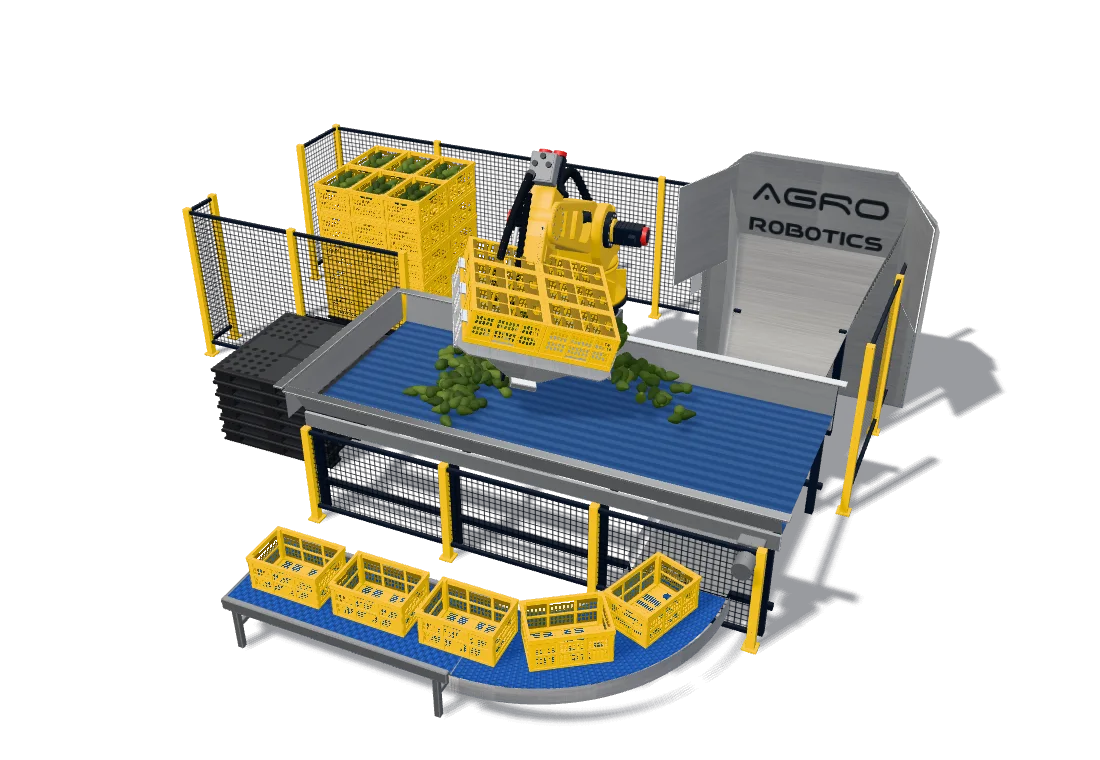
Fruit crate dumping: how to dump without bruising
It is the first hit your fruit takes inside the packing house and the heaviest post on your crew. Here is what is known, with sources, and what is worth measuring.
Where on the line does fruit get bruised the most?
In avocado, at dumping. INIFAP, Mexico's national agricultural research institute, ran a wireless avocado-shaped sensor through the sorting and packing lines of four export packing houses in Mexico (measured in 2012, published in 2017): the hardest impacts happened on the dump belt, and slowing it down did not reduce them. Internal damage shows only at eating ripeness, as darkening and cavities.
That is why an avocado can leave your packing house perfect on the outside and reach the buyer's home black inside. You will not see the problem at the sorting table. You will see it in a claim, weeks later.
Drop height sets the hit
The speed a fruit arrives at depends on how far it falls, no matter how fast your belt runs. Move the number. If a 30 cm drop sounds small, think of it as 8.7 km/h against sheet metal.
2.43 m/s
That is the speed it hits whatever is below, or 8.7 km/h. It takes 0.25 s to fall.
| Drop height | Impact speed | Fall time |
|---|---|---|
| 10 cm | 1.40 m/s | 0.14 s |
| 20 cm | 1.98 m/s | 0.20 s |
| 30 cm | 2.43 m/s | 0.25 s |
| 50 cm | 3.13 m/s | 0.32 s |
| 80 cm | 3.96 m/s | 0.40 s |
Free fall, v = √(2gh), ignoring air. That is the physics: how much it damages depends on the fruit, its ripeness and the surface it lands on.
How does your fruit arrive? Each infeed asks for something else
| Infeed | Where you see it | How it gets dumped | What to watch |
|---|---|---|---|
| Plastic crates on pallets | Avocado, tomato, mango, bell pepper | By hand, with an in-line tipper or with a robot that takes the whole layer | The load: 20 to 25 kg per crate, hundreds of times a shift. The height above the hopper |
| Bins | Apple and citrus | Dry dumper with slow rotation, or in water | The flow: hundreds of kilos that must not come down all at once |
| Gondola | Tomato and bulk vegetables | Unloading by water flume or by hand | Water management, for food safety |
| Loose crates | Small volume or small grower | By hand onto a table or hopper | Repetition, and a table at a good height |
How to soften the hit before buying anything
Measure the height
With a tape measure, from where the crate lets go to where the fruit lands. For every person and on every shift.
Cover the sheet metal
Soft material at every transfer point. Check that it can be cleaned: quality will ask you for that.
Run a sensor
There are fruit-shaped sensors that travel down the line and record every hit. That is the measurement INIFAP used.
Cut and wait
Set fruit aside by station, let it ripen and cut it open. It is the cheap way to see where internal damage starts.
How many people does dumping by hand take?
There is a legal floor. NOM-036-1-STPS-2018, Mexico's manual handling standard, sets 25 kg per lift for men aged 18 to 45, 20 kg for women aged 18 to 45, and a cumulative mass of 10,000 kg per 8-hour workday when the load is carried less than 10 meters.
The math: people = kg per hour × 8 ÷ 10,000. A 2 t/h line takes at least 2 people per shift; a 5 t/h line, at least 4. That is the minimum under the standard, with no breaks. Agro Robotics calculation.

Illustrative demonstration. Your cell comes from your layout.
Questions about fruit crate dumping
What is fruit crate dumping?
Does slowing the dump belt reduce bruising?
Dumping in water or dry?
How do you dump bins without bruising the fruit?
How many people does dumping by hand take?
Keep reading
Sources
Have you measured your drop height yet?
If you like, we can review it together with a video of your dumping area. Tell us which fruit and which crate.