
NOM-036 in fruit packing houses: how much each person can lift per shift
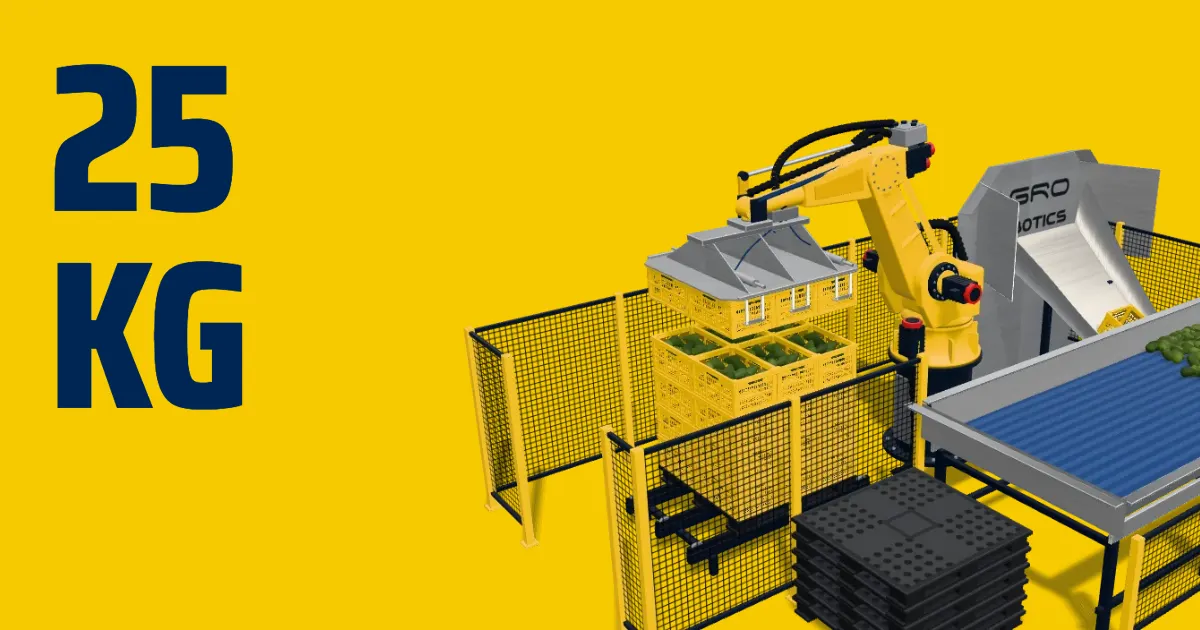
NOM-036-1-STPS-2018, Mexico's manual handling standard, caps each lift at 25 kg for men aged 18 to 45 and 20 kg for women of that age, with 10,000 kg accumulated per workday at less than 10 m. It hits dumping and stacking; placing fruit in the box almost never falls under it.
In Mexico, NOM-036-1-STPS-2018, the manual handling standard (DOF, the official federal gazette, November 23, 2018), limits a lift to 25 kg for men aged 18 to 45 and to 20 kg for women of that age, with 10,000 kg of accumulated mass per workday at less than 10 m. By an Agro Robotics calculation with that accumulated mass, dumping a 5 t/h line by hand takes at least 4 people per shift.
In this article
- How much weight can a person lift under NOM-036?
- Accumulated mass: how many crates make 10,000 kg
- How many people does it take to dump a 5 t/h line?
- NOM-036 in fruit packing houses: covered and barely covered
- What does NOM-036 ask of the employer besides weight?
- Does NOM-036 force you to buy a machine?
- What to measure on your line this week
Four hundred 25 kg crates add up to 10,000 kg, and that is where one person’s shift ends under NOM-036 in fruit packing houses and in any workplace in Mexico where the load is carried less than 10 meters (NOM-036-1-STPS-2018, Mexico’s manual handling standard, section 8.3 b) 5, DOF, November 23, 2018). That is 50 crates an hour, eight hours straight, and the eleven o’clock truck does not ask how many you have done.
The first job to collide with that number is the one at the hopper. If crates still get tipped by hand there, a fruit crate tipper is one way out, and the standard recognizes cheaper ones that are worth reviewing first.
This text cites sections from the DOF, Mexico’s official federal gazette, and is not legal advice: a labor lawyer or your safety manager has to validate your case.
How much weight can a person lift under NOM-036?
Table 1 of section 8.3 b) 2 sets a cap per lift, by age and gender. It is on page 26 of the First Section of that day’s DOF.
| Person | Age | Cap for lifting or lowering |
|---|---|---|
| Woman or man | Under 18 | 7 kg |
| Woman | Over 45, with a medical evaluation | 15 kg |
| Man | Over 45, with a medical evaluation | 20 kg |
| Woman | 18 to 45 | 20 kg |
| Man | 18 to 45 | 25 kg |
A note on the third row: in the official DOF copy, the kilo cell for men over 45 comes out blank, right below the 20. The technical guide from IMSS, Mexico’s social security institute, reproduces it as 20 kg, and that reading is the one used here. Someone over 45 who has a doctor’s endorsement can reach the cap of the 18 to 45 group.
Those numbers are a ceiling. The standard asks you to go lower depending on frequency, distance, position of the load and grip: the crate in the last layer, down at the floor, weighs the same as the one in the first and is much harder to lift. If the wooden crate splinters, section 8.3 a) 9 calls for gloves. During pregnancy, and up to 10 weeks after delivery, the standard prohibits loads over 10 kg (8.3 b) 1).
Before you argue, put the full crate on the receiving scale: if it holds 25 kg of fruit, with the plastic it is already over the cap. With a 25 kg crate, only part of your crew can cover the hopper job.
Accumulated mass: how many crates make 10,000 kg
Section 8.3 b) 5 sets two caps per 8-hour workday for manual carrying: 10,000 kg at less than 10 m and 6,000 kg at no more than 20 m. So the tape measure matters as much as the scale. A pallet left 12 m from the hopper cuts the cap by 40% for whoever empties it.
| Full crate or box | Crates or boxes per person per workday, at less than 10 m | At no more than 20 m | Per hour, at less than 10 m |
|---|---|---|---|
| 25 kg | 400 | 240 | 50 |
| 20 kg | 500 | 300 | 62 |
| 11.34 kg | 881 | 529 | 110 |
| 10 kg | 1,000 | 600 | 125 |
| 4 kg | 2,500 | 1,500 | 312 |
Agro Robotics calculation: the cap divided by the weight of the crate or box, rounded down, over an 8-hour shift. The 4 kg box looks light until you count 2,500 in a shift.
Two reading notes. The evaluation table in section 12.3 speaks of 10,000 kg per day of lifting and carrying without separating distances, so if your carry goes past 10 m, take the lower cap. And beyond 20 m this section gives no figure at all.
How many people does it take to dump a 5 t/h line?
The math is kilos per hour × 8 ÷ 10,000. A line running 5 t/h, metric tons per hour, moves 40,000 kg in 8 hours: at least 4 people per shift dumping, if the carry is under 10 m. With a 25 kg crate that is 200 crates an hour, one every 18 seconds.
| Line | Kilos in 8 hours | People, at less than 10 m | People, at no more than 20 m |
|---|---|---|---|
| 2 t/h | 16,000 | 2 | 3 |
| 3.5 t/h | 28,000 | 3 | 5 |
| 5 t/h | 40,000 | 4 | 7 |
| 8 t/h | 64,000 | 7 | 11 |
Agro Robotics calculation, rounded up. It assumes each person reaches exactly their cap and that the line runs evenly, with the full crew. Read it as the legal floor: the headcount that holds up through a season sits above it.
If the shift runs longer, the math gets complicated. The same line at 12 hours moves 60,000 kg, which at the same cap means 6 people, and the section only speaks of an 8-hour workday. That question goes to your lawyer before the peak, along with the overtime rules of the 2026 reform.
Is your number in crates instead of metric tons? The boxes per minute tool converts it, and how many boxes per minute a packing line needs explains why the dumping rate and the packing rate differ.
NOM-036 in fruit packing houses: covered and barely covered
The scope (sections 2 and 2.1) reaches anyone who handles loads more than once a day and leaves out loads under 3 kg. Job by job:
| Job | Covered? | Why |
|---|---|---|
| Dumping a field crate, or reja, into the hopper | Yes | It gets lifted and carried all shift, and it weighs far more than 3 kg |
| Taking crates off the pallet by hand | Yes | It counts against Table 1 and against the accumulated mass |
| Stacking full boxes at the end of the line | Yes | Box of 4, 10 or 11.34 kg: it weighs little and adds up fast |
| Returning empty crates | Depends on their weight | Covered if the empty crate weighs 3 kg or more |
| Pushing pallets with a pallet jack or hand truck | Yes, with other measures | Item 8.3 c) asks you to check the floor, the wheels and the rated capacity of the equipment |
| Placing fruit piece by piece | Almost never | Each piece weighs less than 3 kg |
| Sorting on the belt | Almost never | It is piece by piece too |
It has to be said plainly: for filling the box fruit by fruit, this standard is almost no use as an argument. That job wears people out through repetition, and its case is built on rate and on fruit, as told on the robotic case packer for fruit page. Saying that NOM-036 forces you to automate placing fruit in the box would be false.
What does NOM-036 ask of the employer besides weight?
- Ergonomic risk analysis (section 5.1 and chapter 7).
- Safety procedure (8.2) and physical fitness endorsed by a doctor (8.1).
- Ergonomics program, only if the analysis calls for it (8.4), with execution dates no more than a year out (8.5).
- Health surveillance by a doctor with knowledge of occupational medicine; the file is kept at least five years (9.3 and 9.4).
- Training before starting for new hires, a refresher at least every two years, and records (10.2 to 10.4).
In season, section 10.2 hits twice as hard: every person who comes in for the peak gets trained before lifting the first crate.
On when it took effect, the transitory articles in the DOF give January 2, 2020, and January 4, 2023 for sections 5.1, 8.3 b) 2, 8.4, 8.5 and chapter 7. A 2024 joint statement from the STPS, Mexico’s labor ministry, speaks of an extension until March 2024. With either date, the standard is already in force.
The fine for failing to observe safety and hygiene standards runs from 250 to 5,000 UMA, Mexico’s reference unit for fines, under the Federal Labor Law (LFT, article 994, section V): from 29,327.50 to 586,550 pesos with the UMA of 117.31 pesos in effect since February 2026, Agro Robotics calculation.
Does NOM-036 force you to buy a machine?
No. When the load exceeds Table 1, section 8.3 b) 3 gives three paths, and sections 8.6 and 8.7 add administrative and technical measures for when your analysis calls for them.
| Measure | How it looks on the packing floor | How far it goes |
|---|---|---|
| Lifting team | Two people lift two-thirds of the sum of their capacities: 26.7 kg for two women aged 18 to 45, 33.3 kg for two men. Three lift half of the sum | It solves the cap per crate and takes twice the people on every lift |
| Auxiliary equipment | Cart, hand truck, pallet jack | It brings the pallet closer and shortens the distance. The crate still gets lifted to tip it |
| Splitting the load | Filling the crate to 20 kg | More people qualify for the job. At 5 t/h that is 250 crates an hour instead of 200 |
| Administrative | Rotating, scheduling breaks, limiting frequency | They spread the accumulated total. The kilos on the line stay the same |
| Technical | Changing the procedure or replacing machinery and equipment | They take the lifting out of the job, and they cost money |
The team kilos are an Agro Robotics calculation using the rule in that section. The IMSS technical guide recommends exhausting mechanical aids or automation before deciding that someone lifts by hand, as long as they bring no other risks; that is a recommendation from a guide, and the obligation sits in the standard. The standard asks you to control the risk and lets you choose how.
If you do get to the machine, the options run from a simple crate tipper to a robot: the difference between a crate tipper and a crate dumper and the fruit crate dumping guide sort them out. For reference, Agro’s robot takes the full layer of plastic crates off the pallet, with nobody carrying it. If your weight sits at the end of the line, the subject is fruit box palletizing. And what to do with whoever holds that job today is covered in automating a fruit packing house without layoffs.
What to measure on your line this week
Five numbers come from a scale, a tape measure and the crew list: the weight of the full crate, the meters from the pallet to the hopper, the kilos per hour at peak, how many people lift per shift, with their age and gender, and how many hours the shift lasts in season. With that, your safety manager puts together the chapter 7 analysis, the first obligation on the list (section 5.1).
Frequently asked questions
How many kilos can a worker lift in a fruit packing house?
Can a woman dump 25 kg crates on her own?
How much is the fine for failing to comply with NOM-036?
Does the standard also count for seasonal temporary workers?
If I buy a fruit crate tipper, do I comply with NOM-036?
Sources
- STPS, NOM-036-1-STPS-2018, manual handling of loads, DOF, November 23, 2018 (Table 1 checked in the official copy, page 26 of the First Section) (in Spanish)
- IMSS, ELSSA, technical guide to the procedure for safe handling of loads, with no visible date, consulted on November 4, 2026 (in Spanish)
- STPS, Joint statement 19/2024, entry into force of NOM-036 (in Spanish)
- Cámara de Diputados, Ley Federal del Trabajo, art. 994, last amended DOF May 14, 2026 (in Spanish)
- INEGI, Press release 1/26, value of the UMA for 2026, January 8, 2026 (in Spanish)