
How many boxes per minute a packing line needs: formula and table by box weight
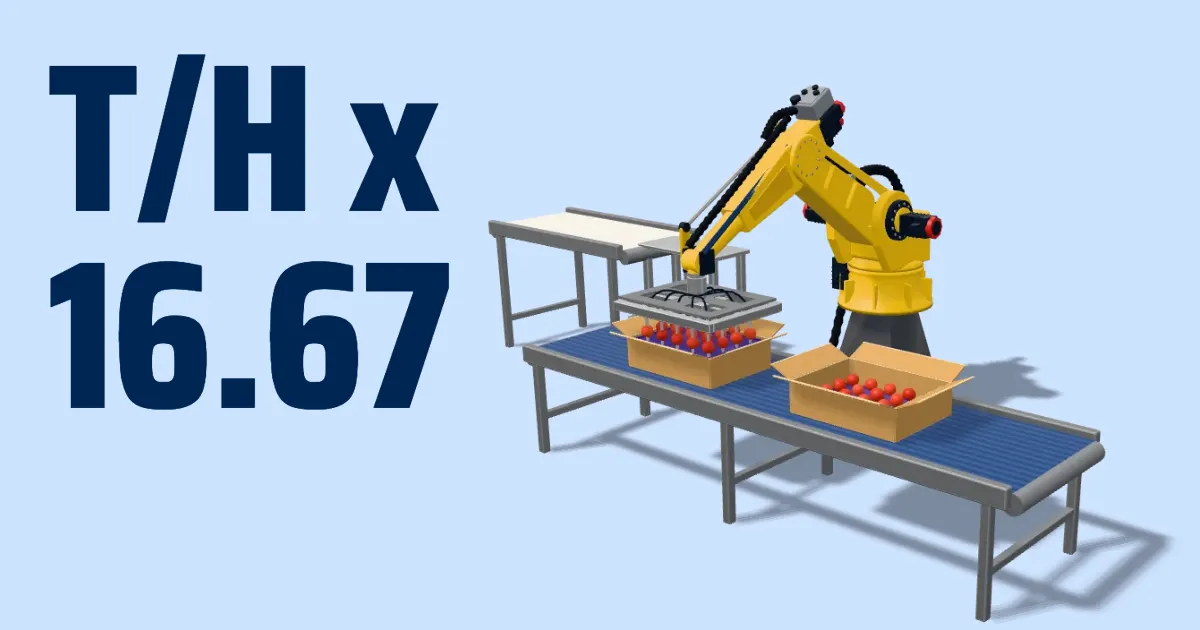
You get it with one division: metric tons per hour times 16.67, divided by the kilos in the box. The infeed and the outfeed give different figures, and each one decides a different machine.
A fruit packing line in Mexico needs as many boxes per minute as you get by multiplying its metric tons per hour by 16.67 and dividing by the kilos in the box. At 6 t/h that is 4 crates of 25 kg per minute at dumping and 8.8 boxes of 11.34 kg at packing, according to an Agro Robotics calculation.
In this article
At 6 metric tons per hour, the same fruit is 4 crates per minute at the infeed and 25 boxes at the outfeed, if it arrives in a 25 kg field crate and leaves in a 4 kg box (Agro Robotics calculation). That is why how many boxes per minute a packing line needs has two answers, and each end of the line gets bought with its own: the fruit crate tipper with the infeed figure and the robotic case packer for fruit with the outfeed figure.
How many boxes per minute a packing line needs: the formula
Boxes per minute = metric tons per hour × 1,000 ÷ kilos per box ÷ 60
The notebook shortcut is to multiply the metric tons by 16.67 and divide by the kilos. If you prefer to skip the hand math, the boxes per minute calculator does it for you.
Agro Robotics calculation, assuming all the fruit leaves in a single box:
| Line | 4 kg box | 11.34 kg box | 25 kg field crate |
|---|---|---|---|
| 2 t/h | 8.3 | 2.9 | 1.3 |
| 3 t/h | 12.5 | 4.4 | 2.0 |
| 5 t/h | 20.8 | 7.3 | 3.3 |
| 6 t/h | 25.0 | 8.8 | 4.0 |
| 8 t/h | 33.3 | 11.8 | 5.3 |
| 10 t/h | 41.7 | 14.7 | 6.7 |
Where those weights come from. The 4 kg box is the basis of the Codex sizes, a European practice, according to NMX-FF-016-SCFI-2016, Mexico’s Hass avocado standard. The 11.34 kg box is the 25 lb of the two-layer box (Index Fresh, accessed November 4, 2026). The 25 kg crate is the plastic orchard crate that Folleto 37 from INIFAP, Mexico’s national agricultural research institute, describes for mango (2019).
The capacities in the first column cover the range that packing line manufacturers publish on their spec sheets, accessed November 4, 2026.
Why do the dumping rate and the packing rate differ?
Four reasons, from the most obvious to the one people forget most.
The crate and the box weigh different amounts. As shown above: 25 kg at the infeed, between 4 and 11.34 kg at the outfeed.
Only part of the fruit that comes in leaves in that box. Some goes to the domestic market, to shrink or to another pack format. USDA reports, citing the industry, that close to 20% of Mexico’s avocado production goes to processing, most of it fruit that is unfit for export (March 2026). That figure is for the country; yours comes out of your own fruit packing house. The math ends up like this: outfeed boxes = boxes from the table × your percentage of fruit that does go into that box.
The outfeed gets split by size. Each table sees only its share. If 30% of the fruit on a 6 t/h line comes out as size 48, that table gets 1.8 t/h, 2.6 boxes of 25 lb per minute (Agro Robotics calculation; the 30% is an assumption, put in your own). A machine for that table gets sized with 2.6, and sized with 8.8 it ends up oversized on every count.
The infeed stops and so does the outfeed. Between pallets, between lots and whenever something jams. Rochín says its continuous dumper “minimizes gaps without product as far as possible”: those gaps on the belt pull your average below the nameplate figure.
Size the infeed with the figure for the line and the outfeed with the figure for each table.
Which t/h figure do I use: nameplate or scale?
The scale figure, in your heaviest week. Published capacities come with their conditions: CIU gives 7 t/h for its Mini Packing V2 with fruit averaging 200 g, and LORA says “depending on your product and configuration” (both accessed November 4, 2026). At 200 g, those 7 t/h are 583 pieces of fruit per minute (Agro Robotics calculation). If your fruit weighs something else, your line does something else.
To get your number, take the kilos received over the scale in the busiest shift of the year and divide by the hours the line ran with fruit, leaving out the meal break and the startup. Do it by month as well. In avocado the difference weighs a lot: USDA reports 136,000 metric tons exported in four weeks of January and February (March 2026). Buying with the nameplate figure means sizing for a line you do not have.
If you count boxes instead of kilos, stand at the end of a table for 15 minutes with your phone on stopwatch, count finished boxes and multiply by four. It is rough and it is yours.
How many boxes can a machine do, and how many do you need?
The infeed almost never runs short on rate. Published crate tippers go from 12 to 15 crates per minute (Rochín) to 22 and up to 36 (Zaizer), accessed November 4, 2026. A 6 t/h line asks for 4. The problem at the infeed is load: at 5 t/h, the accumulated mass in NOM-036-1-STPS-2018, Mexico’s manual handling standard, takes at least 4 people per shift dumping by hand (5,000 kg × 8 ÷ 10,000, a calculation with the accumulated mass at less than 10 m). The legal detail is in NOM-036 in fruit packing houses.
At the outfeed you do have to run the numbers. In case packing, the figures are published in pieces: Greefa gives up to 100 pieces per minute and 1.2 t/h (accessed November 4, 2026). At size 48 that is 2.1 boxes of 25 lb per minute (Agro Robotics calculation). To go from pieces to boxes by size, use the table in how many avocados per minute a robot packs.
The infeed gets bought on load and on impact; the outfeed, on the rate at each table.
How many boxes is that per shift and per week?
A 6 t/h line that runs 8 hours moves 48 metric tons. That is 1,920 field crates of 25 kg and 4,233 boxes of 25 lb, if all the fruit leaves in that box (Agro Robotics calculation). That outfeed volume is the one that fills pallets: the math continues in how many fruit boxes per pallet.
The workweek goes into the formula too. The DOF, Mexico’s official federal gazette, of May 1, 2026 lowers the workweek to 46 hours in 2027 and to 40 in 2030, with no cut in pay. To move the same volume with the same shifts:
| Year | Workweek | Hourly rate against 48 h |
|---|---|---|
| 2027 | 46 h | +4.3% |
| 2028 | 44 h | +9.1% |
| 2029 | 42 h | +14.3% |
| 2030 | 40 h | +20.0% |
Agro Robotics calculation, without overtime or added shifts. If your line already runs flat out at peak, that difference comes from another shift, from overtime within its caps or from cutting stoppages, and it pays to look at it before the season. The context is in the 40-hour workweek in fruit packing houses.
Your two numbers for any quote are the field crates per minute in your heaviest month and the boxes per minute at the table you want to automate. At 6 t/h, with 30% in size 48, they are 4 and 2.6.
Frequently asked questions
My grader says 8 t/h. How many boxes come out per minute?
Why does my crate tipper have rate to spare while my packing table does not?
Does the 46-hour workweek force me to raise the line rate?
How many people do I need dumping crates at 5 metric tons per hour?
Sources
- LORA Automation, line capacity, accessed Nov 4, 2026 (in Spanish)
- CIU, Mini Packing V2, accessed Nov 4, 2026 (in Spanish)
- Zaizer, crate tipper (volteadora de cajas), accessed Nov 4, 2026 (in Spanish)
- Industrias Rochín, torsion crate dumper, accessed Nov 4, 2026 (in Spanish)
- Index Fresh, size and 25 lb box, accessed Nov 4, 2026
- NMX-FF-016-SCFI-2016, Hass avocado (in Spanish)
- Osuna García, INIFAP, Folleto Técnico 37 on mango packing, December 2019 (in Spanish)
- USDA FAS, Avocado Annual, MX2026-0019, Mar 12, 2026
- NOM-036-1-STPS-2018, DOF, Nov 23, 2018 (in Spanish)
- Decree amending the Ley Federal del Trabajo, Mexico's Federal Labor Law, DOF, May 1, 2026 (in Spanish)
- Greefa, SmartPackr for avocados, accessed Nov 4, 2026 (in Spanish)
- Industrias Rochín, continuous bin dumper, accessed Nov 4, 2026 (in Spanish)