
How many avocados per minute a robot packs: published figures in pieces, boxes and t/h
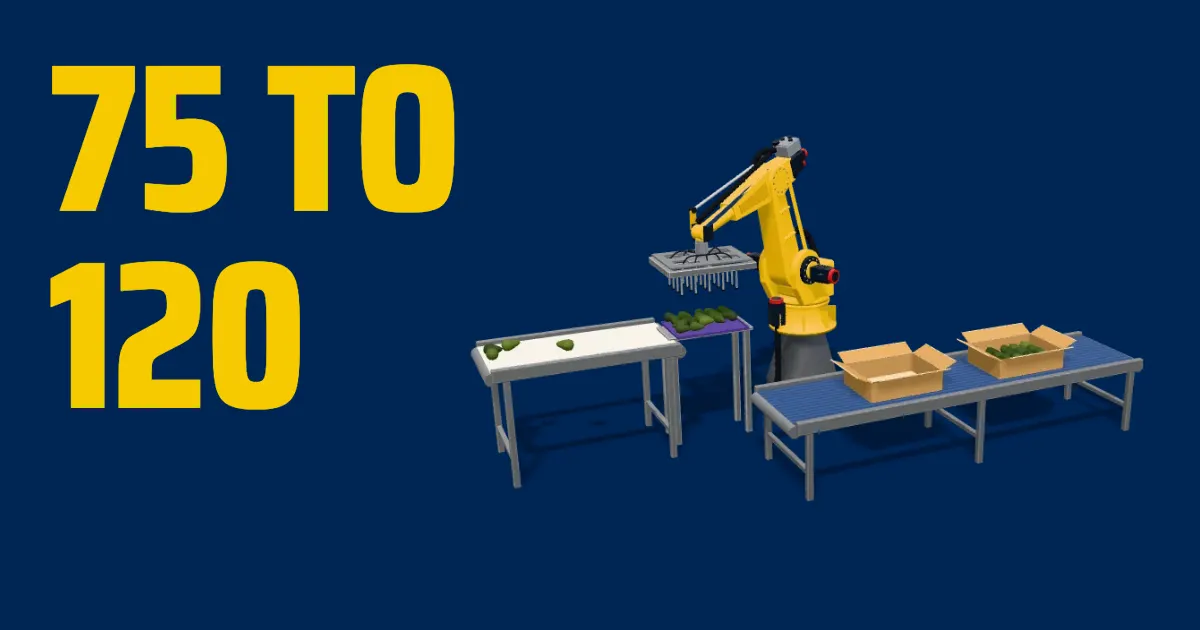
Spec sheets published as of November 2026 run from 75 to 120 pieces per minute per machine, and reach 240 in a system with three conveyors. In a 25 lb box at size 48, 120 pieces per minute are 2.5 boxes.
A robot packs 75 to 120 avocados per minute according to published figures: Greefa declares up to 100 (2026) and Intello 75 to 120 (FreshPlaza, 2026). Selo's Speedpacker reaches 240 with three conveyors (FreshPlaza, 2021). At size 48 in a 25 lb box, 120 pieces per minute equal 2.5 boxes per minute and 1.7 t/h, according to an Agro Robotics calculation.
In this article
One hundred avocados per minute and 1.2 metric tons per hour are the same line on a spec sheet if each piece weighs 200 grams (Agro Robotics calculation with Greefa data, 2026). That is why, when you ask how many avocados per minute a robot packs, the useful answer comes with three numbers: pieces, boxes and metric tons. Here are the ones the manufacturers publish, with their dates, and the way to carry them over to your line before you ask for a quote on an avocado packing line.
How many avocados per minute a robot packs, as published
All of these are figures declared by whoever sells or operates the equipment. No source gives test conditions.
| Machine | Published figure | What the source clarifies | Source and date |
|---|---|---|---|
| Greefa SmartPackr | Up to 100 pieces per minute; 1.2 t/h | “Depending on the application”; fruit from 60 to 100 mm; single or double, without saying which one the figure belongs to | Greefa, accessed November 4, 2026 |
| Intello Fruit Packer | 4,500 to 7,000 pieces per hour, about 75 to 120 per minute | Varies with the fruit; round or oval, avocado included | FreshPlaza, November 2, 2026 |
| Selo Speedpacker | 240 avocados per minute | Three conveyors with assigned robots | FreshPlaza, May 12, 2021; Viro, accessed November 4, 2026 |
| MAF Roda Speed Packer | Does not publish a figure | Versions for avocado, with suction cups and pocketed plates | MAF Roda México, accessed November 4, 2026 |
| Viscon SwiftPick | Does not publish pieces per minute | Compared per square meter against delta robots | FreshPlaza, March 19, 2025 |
The Speedpacker case teaches you how to read the others. According to the project published on Viro’s site, Selo sells that machine by total output: capacity per robot, multiplied by the number of robots and by a safety factor. The 240 avocados per minute belong to the complete installation, and neither that page nor FreshPlaza says how many robots make it up.
Outside avocado the gap opens wider. Greefa itself publishes up to 320 apples per minute per unit for its TrayPackr, with multi-head arms, and 45 to 50 pieces for its i-PACKR, in trials with delivery planned for the fourth quarter of 2026. Those are two machines from a single brand for a single fruit.
Before you compare two figures, ask whether they are per robot, per belt or per complete system.
Pieces, boxes and metric tons: how to convert them
Two formulas cover almost everything:
- Boxes per minute = pieces per minute ÷ pieces per box.
- Metric tons per hour = pieces per minute × kilos per piece × 60 ÷ 1,000.
The size already carries the first figure. In avocado, the size says how many pieces fill a 25 lb box: “48” means 48 avocados with a net weight of 25 lb, that is 11.34 kg (Index Fresh, accessed November 4, 2026). For that size, Avocados From Mexico publishes 7.5 to 9.5 ounces per piece, about 213 to 269 g (2025).
That gives this table, an Agro Robotics calculation with the 25 lb box and the average weight you get by dividing 11.34 kg by the count:
| Size | Grams per piece | Boxes per minute at 100 pieces | Boxes per minute at 120 pieces | t/h at 120 pieces |
|---|---|---|---|---|
| 32 | 354 | 3.1 | 3.8 | 2.6 |
| 40 | 284 | 2.5 | 3.0 | 2.0 |
| 48 | 236 | 2.1 | 2.5 | 1.7 |
| 60 | 189 | 1.7 | 2.0 | 1.4 |
| 70 | 162 | 1.4 | 1.7 | 1.2 |
| 84 | 135 | 1.2 | 1.4 | 1.0 |
Read the table from the bottom up and you can see why two fruit packing houses with the same robot report different things. The small size fills fewer boxes with the same machine. The same happens with weight: at size 84 the machine moves a little more than half the metric tons it moves at 48, at the same rate of pieces. If you are going to measure against a spec sheet, note the size that was running that day. For 2025, USDA reported high availability of 40s and 48s (March 2026), so the 48 is a good basis for a first calculation; the one for your line comes from your packing records.
The box format moves the count just as much. NMX-FF-016-SCFI-2016, Mexico’s standard for Hass avocado, notes that the Codex sizes start from a 4 kg container, the practice in Europe. With a 236 g piece, 120 pieces per minute are:
| Box | Pieces per box | Boxes per minute |
|---|---|---|
| 4 kg | 17 | 7.1 |
| 11.34 kg (25 lb) | 48 | 2.5 |
Agro Robotics calculation. In the 4 kg box that is almost three times more box changes per minute, and each change is a box that has to come in, stop and leave on time.
Is one robot enough for my whole line?
Usually one robot falls short. A 6 t/h line turns out 8.8 boxes of 25 lb per minute. At 1.7 t/h per machine, filling all of it takes 3.5 machines (Agro Robotics calculation). And the fruit on a line does not all come out at one point: it is split by size among tables. The reasonable move is to start with the outlet that concentrates the most boxes and leave the others with their crew. The full calculation, with the difference between dumping and packing, is in how many boxes per minute a packing line needs.
Why does the spec sheet figure drop on your floor?
Look at how the sources word it: Greefa says “depending on the application”; JTech, which sells the Aporo in Australia, publishes its 120 pieces per minute for optimal conditions; Intello says it varies with the fruit. Each one leaves the door open, and with good reason. These are the things that usually eat into the rate on the floor:
- Gaps on the belt, when the fruit arrives unevenly and the robot waits.
- Mixed sizes at one outlet, above all if pieces are rejected one by one.
- The box change, which repeats more often in a small format.
- Orientation. If your customer asks for the label in view, orienting each piece takes time.
Nobody publishes how much each cause weighs. There is also no reliable public figure for the pieces per minute of a person packing by hand in Mexico, so your reference is your crew.
Time your crew and the machine with the same box: that count holds up in the meeting with finance.
What should you ask at a demonstration?
| Question | What to write down |
|---|---|
| Is the figure per robot, per belt or per system? | Number of robots and of belts in the demonstration |
| Does it run with my fruit, my size and my box? | Size, box weight and pack pattern, in writing |
| How many finished boxes come out in 15 minutes? | Boxes with the correct pack pattern, counted by you; the robot’s cycle count does not work for this |
| How long does a format change take? | Minutes, from the last box of one format to the first good box of the next |
| Does the label stay visible? | Sample of boxes checked by quality |
| At what height does it release the fruit? | Centimeters, with the fruit drop height tool |
| How does the flesh turn out? | Boxes set aside until eating ripeness, because INIFAP, Mexico’s national agricultural research institute, saw the internal damage there (2017) |
| What happens if it stops at peak? | Manual plan and response times; check in-season support |
For Agro’s robotic case packer for fruit there are only public demonstrations: ask for that sheet to be filled in with your fruit before you decide.
At 120 pieces per minute, a machine at size 48 fills 150 boxes per hour and 1,200 in an 8-hour shift, if it never stops (Agro Robotics calculation). At the demonstration, count the ones that came out in 15 minutes and multiply by four.
Frequently asked questions
How many avocados per minute does a robot pack on a normal line?
My line turns out 8 boxes per minute. Is one robot enough?
Does the robot leave the avocado label facing up?
If I run it faster, does it bruise the fruit more?
Sources
- Greefa, SmartPackr for avocados, accessed Nov 4, 2026 (in Spanish)
- Greefa, i-PACKR, accessed Nov 4, 2026 (in Spanish)
- Greefa, Automatic TrayPackr for apples, accessed Nov 4, 2026 (in Spanish)
- FreshPlaza, Intello Fruit Packer, Nov 2, 2026
- FreshPlaza, Selo's Speedpacker in Maasdijk, May 12, 2021
- Viro, Speedpacker project, accessed Nov 4, 2026
- FreshPlaza, Viscon's SwiftPick, Mar 19, 2025
- MAF Roda México, Speed Packer, accessed Nov 4, 2026 (in Spanish)
- JTech Systems, Aporo, accessed Nov 4, 2026
- Rural News, Aporo II, Jul 8, 2022
- Index Fresh, what size means in a 25 lb box, accessed Nov 4, 2026
- Avocados From Mexico, size chart, 2025
- USDA FAS, Avocado Annual, MX2026-0019, Mar 12, 2026
- NMX-FF-016-SCFI-2016, Hass avocado (in Spanish)
- Herrera-González and Salazar-García, INIFAP, impacts on Hass avocado on the packing line, 2017 (in Spanish)