
How many fruit boxes per pallet: export spec sheets and calculation
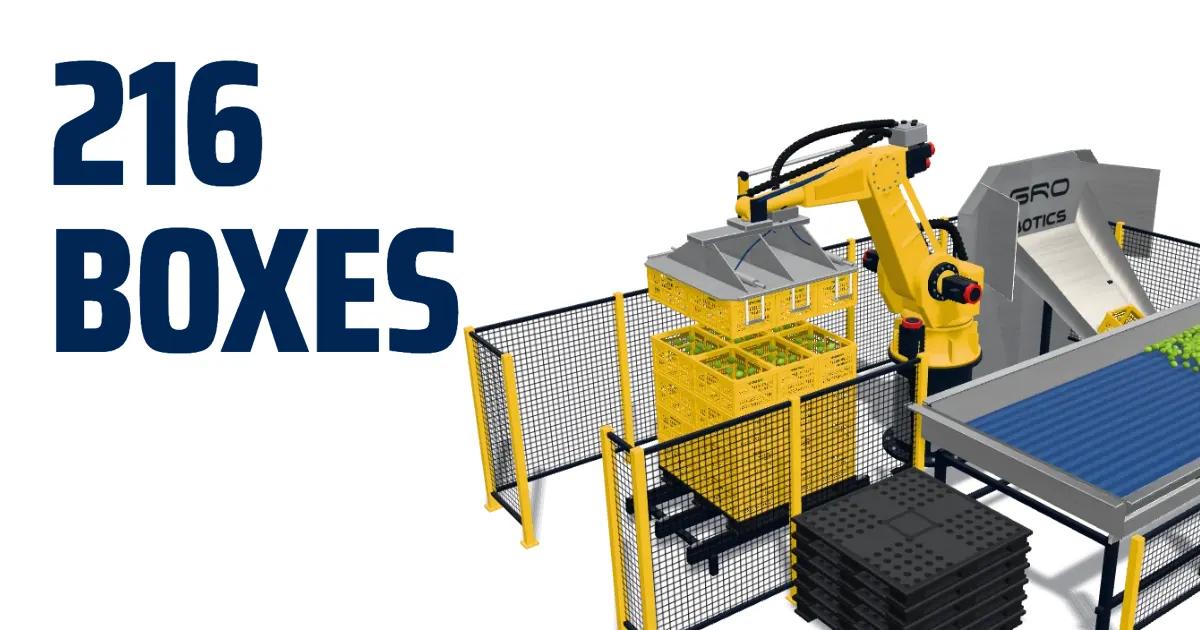
A 1.00 x 1.20 m pallet takes about 216 boxes of 4 kg, 90 to 96 of 10 kg and 80 of 11.34 kg. That is 860 to 960 kg of fruit, and it all depends on your box dimensions and on the height your shipment allows.
In Mexico, a Hass avocado spec sheet publishes 216 boxes of 4 kg and 80 of 11.3 kg per pallet. Agro Robotics calculates, with a 1.00 x 1.20 m pallet and a 40 x 30 x 20 cm box, 10 boxes per layer and 8 layers: 80 boxes and 907 kg at 1.75 m high. With the 10,000 kg cap in NOM-036, Mexico's manual handling standard (DOF, 2018), that is 11 pallets per person per workday.
In this article
A pallet of 1.00 x 1.20 m has 1.2 square meters and a 40 x 30 cm box takes up 0.12. The division gives 10, and in this case you get there by turning boxes. How many fruit boxes per pallet comes out of that number multiplied by the layers your height allows.
There is no official table. NMX-FF-016-SCFI-2016, Mexico’s Hass avocado standard, leaves the package dimensions to “the needs of marketing and transportation”, and the 2021 work plan with USDA sets no dimensions either. There are published spec sheets and there is math, and both are here. If what you want is to take stacking out of the crew’s hands, there is fruit box palletizing.
How many fruit boxes per pallet: the table
Agro Robotics calculation. Assumptions: a pallet of 1.00 x 1.20 m and 15 cm high, with no overhang, and the box measured on the outside. Change any dimension and the result changes.
| Box | Assumed outside dimensions | Per layer | Layers | Boxes per pallet | Total height | Kilos of fruit |
|---|---|---|---|---|---|---|
| 4 kg | 33 x 30 x 10.2 cm | 12 | 18 | 216 | 1.99 m | 864 |
| 4 kg | 40 x 30 x 10 cm | 10 | 18 | 180 | 1.95 m | 720 |
| 10 kg | 33 x 30 x 19 cm | 12 | 8 | 96 | 1.67 m | 960 |
| 10 kg | 40 x 30 x 19 cm | 10 | 9 | 90 | 1.86 m | 900 |
| 11.34 kg | 40 x 30 x 20 cm | 10 | 8 | 80 | 1.75 m | 907 |
| 11.34 kg | 43 x 33 x 22 cm | 8 | 8 | 64 | 1.91 m | 726 |
Where the dimensions come from: 33 x 30 cm is the footprint of the tray of 12 per layer in the Cal Poly study for the National Mango Board (12.875 x 11.75 x 4 inches, 2013), 43 x 33 x 22 cm is the 11.3 kg box a buyer asked for on the Cosmos directory (accessed November 4, 2026), and the others are our own assumption. We found no official dimensions for an avocado box.
The last row is the one that teaches the most. Three centimeters in the box footprint can cost you two boxes per layer and 16 per pallet.
What do export spec sheets publish?
| Fruit and box | Boxes per pallet | Kilos | Source |
|---|---|---|---|
| Hass avocado, 4 kg | 216 | 864 | Supplier in Michoacán, sheet accessed November 4, 2026 |
| Hass avocado, 6 kg | 144 | 864 | Same sheet |
| Hass avocado, 11.3 kg | 80 | 904 | Same sheet |
| Hass avocado, 4 kg | 264 | 1,056 | Colombian exporter, 2018 |
| Hass avocado, 10 kg | 96 | 960 | Same exporter |
| Mango, 5 kg tray | 144 | 720 | Cal Poly for the National Mango Board, 2013 |
| Mango, 3.75 kg tray | 195 | 731 | Same study |
The kilos are our own multiplication. Our table matches the Mexican sheet: 12 times 18 gives 216, and 10 times 8 gives 80. The row of 264 boxes would be 12 times 22, and with a 10.2 cm box it reaches 2.39 m (Agro Robotics calculation), a height that only clears a tall door, like the container door further down. A boxes per pallet figure that comes with no box dimensions and no height is of little use for comparing.
Why do you get 8, 10 or 12 boxes per layer?
Because of how the surface gets divided up. With a 40 x 30 cm box on 1.00 x 1.20 m:
- A strip 40 cm wide takes 4 boxes in a row, touching along the 40 cm side.
- The remaining strip, 60 cm wide, takes 6 turned boxes, in 2 columns and 3 rows.
With 33 x 30 cm there is no need to turn anything: 3 by 4 in a block gives 12. With 43 x 33 cm only 8 fit, and a gap is left over.
USDA asks you to stack evenly on the pallet and stabilize the load with strapping, corner boards or palletizing glue, and in vehicles with bottom air delivery, with the vent holes lined up from layer to layer (Handbook 669, 1995). Check that point with your box: turning layers ties the stack together and can block vents.
The pallet of 40 x 48 inches, 1.219 x 1.016 m, appears next to the 1,200 x 1,000 mm one in ISO 6780:2003. With the dimensions in this table it gives the same boxes per layer (Agro Robotics calculation). For export, the wood has to comply with ISPM 15 (APHIS and SENASICA Work Plan, 2021).
How high can you stack a pallet of fruit?
The first thing that gets in the way sets the height, and you check in this order:
- Your cold room. Measure its door and the forklift clearance with the pallet on the forks.
- The container door. A 40-foot high cube reefer measures 2.557 m inside and 2.437 m at the door, and takes 21 pallets of 1.2 x 1.0 m (K-tainer, accessed November 4, 2026).
- The air. USDA asks for at least 10 cm between the load and the ceiling in vehicles with bottom air delivery (Handbook 669, 1995). If the reefer trailer has a red load line, that line rules.
- The box. The cardboard at the bottom carries every layer. Ask your box supplier for the strength that fits your height and your humidity.
The lowest door along the whole route decides your stack height, starting with the door of your cold room.
In a container, weight is rarely what stops you first: with 20 pallets of 864 kg, the Michoacán supplier’s sheet reaches 17,280 kg in a 40-foot unit. On Mexican highways it can stop you. NOM-012-SCT-2-2017, Mexico’s truck weight and dimensions standard, gives a T3-S2 tractor and semitrailer 46.5 t of gross weight on ET and A roads and 38 t on a B road (DOF, Mexico’s official federal gazette, December 26, 2017). If the tractor and the reefer trailer weigh 16 t, an assumption you should confirm with your carrier, a B road leaves you 22 t: about 24 pallets of 907 kg (Agro Robotics calculation).
How many pallets does one person build per shift?
A box of 11.34 kg sits inside the cap per lift in NOM-036-1-STPS-2018, Mexico’s manual handling standard, which is 25 kg for men and 20 kg for women aged 18 to 45. The accumulated mass runs out first: 10,000 kg per 8-hour workday if the load is carried less than 10 meters (DOF, 2018). Agro Robotics calculation with that figure:
| Box | Boxes per person per workday | Pallets per person per workday |
|---|---|---|
| 4 kg, pallet of 216 | 2,500 | 11.6 |
| 10 kg, pallet of 96 | 1,000 | 10.4 |
| 11.34 kg, pallet of 80 | 882 | 11.0 |
Changing the pack format barely moves the kilo count; it does move how many times people bend down. That is 882 lifts against 2,500 in the same shift.
On a line running 5 t/h, metric tons per hour, that is 40,000 kg per shift, so you need at least 4 people stacking at a steady pace, on top of the ones who dump crates (same calculation). The caps by age and sex are in NOM-036 in fruit packing houses. The pieces in each box are in avocado sizes. With your metric tons per hour, the boxes per minute tool gives you the pace at the outfeed.
Measure your box on the outside, with the lid on and full
Cardboard bulges and the lid rides up, and all of that counts as height. On the 4 kg box, one extra centimeter per box is 18 cm more at 18 layers, and the 1.99 m in the table turns into 2.17 m.
Frequently asked questions
How many avocado boxes go on a pallet?
How much does a built avocado pallet weigh?
How many pallets fit in a 40-foot refrigerated container?
Does my American pallet of 40 x 48 inches change the count?
Sources
- Hass avocado spec sheet from a supplier in Michoacán, on Mi Tiendita Virtual of the Mexico City government, accessed Nov 4, 2026 (in Spanish)
- Hass avocado product sheet from a Colombian exporter, 2018, on ConnectAmericas
- Singh and Saha, Cal Poly, packaging study for the National Mango Board, 2013 (in Spanish)
- Cosmos directory, requests for avocado boxes, accessed Nov 4, 2026 (in Spanish)
- Secretaría de Economía, NMX-FF-016-SCFI-2016, Hass avocado, specifications (in Spanish)
- APHIS and SENASICA, Operational Work Plan for Hass avocado from Mexico to the United States, 2021
- ISO 6780:2003, flat pallets, principal dimensions (public sample)
- USDA AMS, Protecting Perishable Foods During Transport by Truck, Handbook 669, 1995
- K-tainer, container sizes, accessed Nov 4, 2026
- STPS, NOM-036-1-STPS-2018, manual handling of loads, DOF, Nov 23, 2018 (in Spanish)
- SCT, NOM-012-SCT-2-2017, maximum weight and dimensions, DOF, Dec 26, 2017 (in Spanish)