
Automating a fruit packing house without layoffs: take away the heavy lifting and reassign people to sorting and inspection
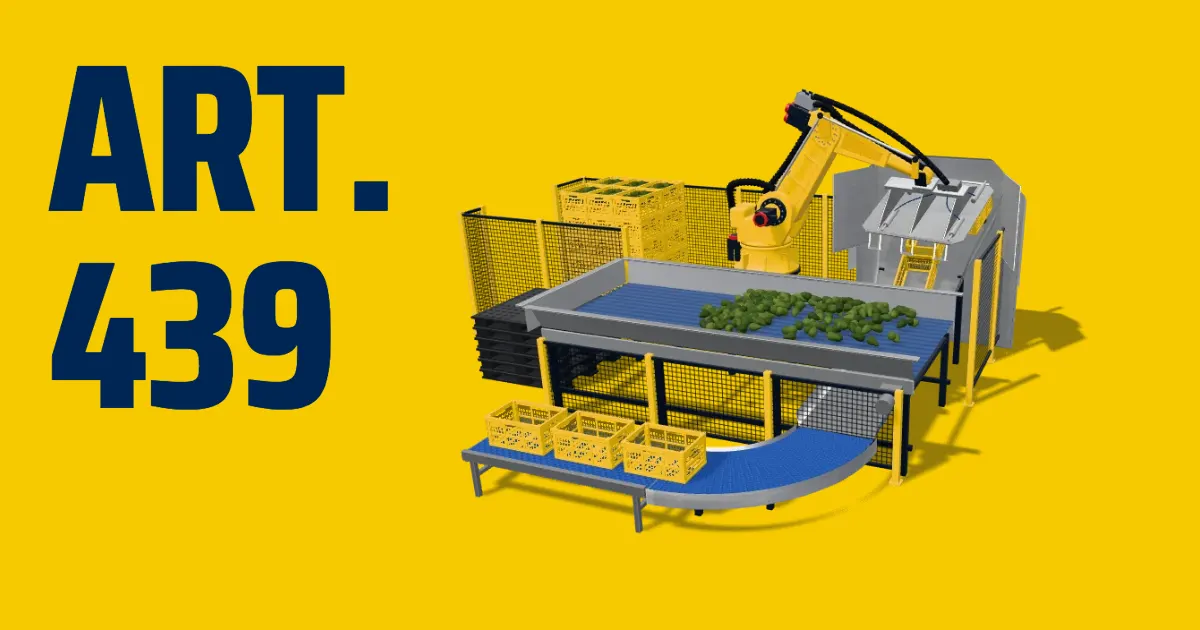
Start with the heavy lifting jobs and reassign those people to sorting and inspection, with training and without touching their wages. If the machine did bring a staff reduction, article 439 of the LFT, Mexico's Federal Labor Law, requires an agreement or authorization from the labor court: go over that with your lawyer before you buy.
In Mexico, automating a fruit packing house without layoffs means moving people from heavy lifting to sorting and inspection. Article 439 of the LFT, Mexico's Federal Labor Law (law last amended: DOF, the official federal gazette, May 14, 2026), requires an agreement or authorization from the labor court if machinery reduces staff, with severance of four months plus 20 days per year. Agro Robotics recommends validating it with a labor lawyer.
In this article
It is only a few steps from the dump hopper to the sorting belt, and almost the whole plan for automating a fruit packing house without layoffs fits in that distance: the person who lifts crates all shift today moves on to checking fruit with their hands free.
This article leaves out any count of people saved. It counts crates: a line running 5 metric tons per hour (t/h) with a 25 kg crate means 1,600 crates in an 8-hour shift (Agro Robotics calculation) that pass through someone’s hands today, and that a fruit crate tipper takes off that job.
The legal points come with citations from the Ley Federal del Trabajo, Mexico’s Federal Labor Law (LFT). This text is not legal advice: a labor lawyer has to validate your case before you sign anything.
Is automating a fruit packing house without layoffs doable?
It is, when the plan is made in the right order: first you choose which heavy job goes away and where the person who holds it will go, and then you buy. It helps to sort the line by what each person lifts, because the legal argument is there too: NOM-036, Mexico’s manual handling standard, recognizes diversifying and rotating activities (section 8.6) and replacing machinery and equipment (8.7) as control measures.
| Job | What it lifts | When it gets automated | Where the person in it can move |
|---|---|---|---|
| Dumping into the hopper | Field crate, capped at 25 kg per lift and 10,000 kg per workday | First | Sorting, inspection or tending the cell |
| Taking crates off and onto the pallet | Full and empty crates | Together with dumping | Receiving and lot control |
| Stacking at the end of the line | Box of 4 to 11.34 kg, many times over | Later | Inspecting box closure and labels |
| Placing fruit in the box | Piece by piece, under 3 kg | Last, after seeing it with your fruit | Sorting and quality |
This table is Agro Robotics’ reading, and every line adjusts it. If your dumping is already mechanical, your first job is a different one.
Why sorting and inspection?
Because a packing house still needs eyes and hands even when a machine does the lifting. The Technical Agreement for the labor certificate itself (DOF, Mexico’s official federal gazette, September 15, 2026) describes the packer by sorting, grading, conditioning, packing, labeling and storage, with traceability of origin. Those are jobs for people who know the fruit: someone with several seasons on the packing floor already tells scab from a harvest bruise.
And those jobs are still there. A grader supplier said in 2023 that the apple-growing region still has many packing houses that sort by hand (FreshPlaza, July 3, 2023). If your line already grades by camera, what remains is culling by hand, checking lots and labels, and tending the cell.
Sorting wears people out in a different way. Standing, eyes on the belt, the same motion the whole workday. You have to rotate and train, and not everyone who dumps crates will want to move there or be able to. Reassigning takes away the heavy lifting; the new job needs its own plan too. For anyone who wants to measure why the hopper matters: in four export packing houses measured in 2012, INIFAP, Mexico’s national agricultural research institute, found the peak impacts at the dumping stage (Herrera-González and Salazar-García, published in 2017), and that story is told in avocado bruising during packing.
What does the law say if the machine does reduce staff?
Article 439 of the LFT applies when installing machinery results in a staff reduction. Absent an agreement, the employer must obtain authorization from the labor court (Tribunal), through the special collective procedure of article 897 and the articles that follow. The people let go in the reduction receive four months of wages, plus 20 days per year of service or whatever their contract says if that is more, and the seniority premium of article 162. Article 437 asks you to take the seniority ranking into account: those with the least seniority go first.
| Seniority | Four months | 20 days per year | Premium of 12 days per year | Total days | At the 2026 minimum wage, in pesos |
|---|---|---|---|---|---|
| 1 year | 120 | 20 | 12 | 152 | $47,886 |
| 3 years | 120 | 60 | 36 | 216 | $68,049 |
| 5 years | 120 | 100 | 60 | 280 | $88,211 |
| 10 years | 120 | 200 | 120 | 440 | $138,618 |
Agro Robotics calculation per permanent employee: four months as 120 days, at 315.04 pesos a day, the 2026 general minimum wage outside the northern border zone. Your lawyer runs it with the integrated wage (salario integrado), with the cap of twice the minimum wage for the premium (articles 162 and 486) and with whatever your contract says.
By its own text, article 439 comes in when there is a reduction. If nobody leaves, the discussion shifts to how to move people. If the plan is to reassign, put it in writing before you sign the purchase.
Can I simply move someone to another job?
It depends on what your contract says. Article 56 Bis allows tasks connected or complementary to the main job, understood as those permanently and directly related to what was agreed or to what the person usually does, and it provides for the corresponding compensation. Moving from the hopper to the belt may fit there or may call for an agreement. Your lawyer settles that with the individual or collective contract on the table.
One point is clear: cutting someone’s wages is grounds for rescission of the employment relationship without liability for the worker (article 51, section IV).
Training is the employer’s obligation (article 153-A), and it is best given outside the peak, with the new person next to someone who already sorts. If your people come by the season, article 39-F allows a discontinuous employment relationship with the same rights in proportion to the time worked, so the plan has to include them too.
How do you talk it over with the crew?
A report from the Universidad de O’Higgins (Chile, 2026) records what anyone would expect to hear on the packing floor: the people who work in packing care that technology lowers the physical effort, and they worry that it lowers employment. We found no equivalent study in Mexico.
- Before the machine arrives. The first news cannot be the forklift unloading the cell.
- The person in charge says it. Owner or packing line manager, on the packing floor, on paid time. If there is a union, with the union first.
- Job by job. Which job changes, who goes where, starting on what date, at what wage and with what training.
- What you do not know yet gets said. An unconfirmed date gets presented as an unconfirmed date.
- It gets tested before the peak. Whoever is going to sort works a few weeks alongside someone who already sorts.
- The manual plan stays alive. If the robot stops in the middle of the season, the line must keep taking crates by hand, and someone trained does it within the limits of the standard. Ask for that plan in writing and weigh it together with in-season support.
If the positions do not add up, it is better to say so in the meeting than in the second month of operation.
What if there is no room for everyone?
Then article 439 enters the conversation before the purchase, with your lawyer and, if there is one, with the union. Check first what you already have: if every season you are short of people on the belt, moving someone from the hopper fills a vacancy you already had, and that is covered in labor shortage in fruit packing houses.
Before you sign, ask for two documents. From your lawyer, the legal route for each job: connected task, agreement or article 439. From your supplier, in writing, which jobs the machine touches, who tends the cell on each shift and what training is included.
Frequently asked questions
Can I bring in a robot without letting anyone go?
What does it cost me if I do have to reduce the workforce?
What if someone does not want to change jobs?
What happens to the people if the machine fails in the middle of the season?
Sources
- Cámara de Diputados, Ley Federal del Trabajo, arts. 39-F, 51, 56 Bis, 153-A, 162, 437, 439, 486 and 897, last amended DOF May 14, 2026 (in Spanish)
- STPS, NOM-036-1-STPS-2018, DOF, November 23, 2018 (in Spanish)
- STPS, Technical Agreement that adds avocado to the Certificado Laboral, DOF, September 15, 2026 (in Spanish)
- Conasami, resolution on the minimum wages in force since January 1, 2026, DOF, December 9, 2025 (in Spanish)
- Universidad de O'Higgins (Chile), occupations report, agricultural packing house packer, 2026 (in Spanish)
- Herrera-González and Salazar-García, INIFAP, Revista Mexicana de Ciencias Agrícolas, Pub. Esp. 19, 2017 (in Spanish)
- FreshPlaza, the Mexican apple sector, July 3, 2023 (in Spanish)