
Fruit crate tipper vs crate dumper: volcador, volteador and where vaciador fits
Volcador, volteador and vaciador name the same machine, the one English calls a crate tipper or crate dumper, depending on who writes the spec sheet. Three differences move your decision: what it empties, whether it works dry or in water, and how the load reaches it.
The difference between volcador and volteador de cajas in Mexico, crate tipper vs crate dumper in English, is one of vocabulary: Rochín writes volcador, Zaizer volteadora and MAF Roda vaciador (sites checked in November 2026). The purchase is decided by the load: crates (12 to 36 per minute published), bins (100 to 180 per hour, calculated) or gondola. Agro Robotics makes a robot that takes the full layer of crates off the pallet and empties it.
In this article
An end-of-line volteadora de cajas turns packages that are already closed. A volteadora de cajas at receiving releases 25 kg of fruit onto a belt. In Mexico both go by the same name, and that confusion gets in the way more than the difference between volcador and volteador de cajas, which is pure vocabulary, like crate tipper vs crate dumper in English. The machine gets chosen for other reasons, and this text is about those.
Rochín writes “volcador de cajas”, Zaizer “volteadora de cajas” and MAF Roda “vaciador de cajas” (sites checked on November 4, 2026), and all three spec sheets describe a field crate that turns until it releases the fruit onto a belt or a hopper. Agro Robotics uses volteador de cajas, the fruit crate tipper, for a search reason: when you type “volcador de bins”, Google first suggests “volteador de bins” (test of November 4, 2026). People also say vaciador, and all three words appear here because your supplier may use any of them.
What separates a crate tipper from a crate dumper?
On the spec sheet, nothing, and the same goes for volcador and volteador de cajas. Each Spanish word has its own turf, and each one carries a meaning that gets in the way when you look for a price.
| Word | Who writes it for fruit | What it gets confused with |
|---|---|---|
| Volcador (dumper) | Rochín and Norda, in Culiacán | Platforms of 50 and 80 t for unloading in bulk, like those of AGHIASA in Guadalajara |
| Volteador or volteadora (tipper) | Zaizer, in Uruapan; Aslan, for crates; Promas, in Hermosillo; INIFAP, Mexico’s national agricultural research institute, writes “máquinas volteadoras” (2017) | The end-of-line volteadora, which turns boxes or packages for handling, like the one from DISPAC |
| Vaciador (dumper, literally emptier) | MAF Roda, Greefa, Agro Robotics | Kitchen utensils, in autocomplete |
| Vaciado (dumping) | It is the stage of the line in the manual by CIAD with SENASICA, Mexico’s agricultural health and food safety agency (2002), and in INIFAP (2017) | Nothing: it is the technical word |
Before you ask for a price, make clear whether you mean a machine that empties fruit or one that only turns closed boxes.
What reaches your packing floor: bins, crates or gondolas?
What comes through the door decides the machine family. These are the published capacities, as each manufacturer states them, checked on November 4, 2026.
| Arrives in | Machine | Published figure | What stays with your people |
|---|---|---|---|
| Loose field crate, the caja de campo or reja | Linear, rotary, continuous or torsion crate tipper | 22 per minute for the linear one and up to 36 for the rotary one (Zaizer); 12 to 15 per minute (Rochín) | Lifting each crate onto the infeed belt |
| Plastic crate on a pallet | Depalletizer with a dumper, or a robot that takes the layer | MAF Roda gives 5 to 6 crates per layer, without crates per minute | Bringing the pallet and, depending on the equipment, removing the empties |
| Bin | Continuous, rotary or torsion bin dumper | 3 bins per minute, stack of up to 4 (Rochín); 100 to 120 bins per hour, 160 with a kit (MAF Roda) | Leaving the stack at the infeed; ask with what equipment |
| Gondola | Unloading by water flume, in the CIAD manual (2002) | No trade name or figure in the spec sheets reviewed | Control of the water and of the unloading |
The field crate deserves its own paragraph. Folleto 37 from INIFAP (2019), a technical bulletin, speaks of 25 kg plastic crates for mango. That weight sits right at the limit that NOM-036-1-STPS-2018, Mexico’s manual handling standard, sets for men aged 18 to 45, and it exceeds by 5 kg the limit for women of the same age. The detail is in NOM-036 in fruit packing houses.
Another detail, less showy: the splintered crate. The CIAD manual asks you to inspect the containers daily and repair or discard the damaged ones, because they injure the product before it reaches any machine.
Dry or in water? It depends on the fruit and the impact
In avocado, dumping is the hardest point of the line. INIFAP ran a fruit-shaped sensor through four export packing houses in September 2012, published in 2017, and found the highest-intensity impacts there. When the speed of that belt was varied, the maximum impact stayed between 6.3 and 8.6 kgF, with no difference between speeds, because the drop height stays the same. The full article is in avocado bruising during packing.
For dry dumping, the FAO (1995 manual) recommends padded ramps or moving belts. Rochín describes something from that family in its continuous dumper: the bin is turned over onto a rotating conveyor and the fruit passes to a belt that sets it down.
For water dumping, the same FAO says that moving chlorinated water, at 100 to 150 ppm, reduces bruises and abrasions. The bill arrives somewhere else. Greefa warns that water treatment is part of the solution and separates fruit that floats from fruit that does not. Folleto 37 from INIFAP (2019) suggests washing at most 600 field crates of mango before changing the water in the tank and returning to 200 ppm of chlorine. Rochín, for its part, offers a tank for receiving fruit that can also serve to disinfect or precool.
Water makes sense when the fruit was already going to be washed or treated at that point. To check your heights you have the fruit crate dumping guide and the fruit drop height tool.
Fixed or forklift-mounted? Hydraulic or electric?
For a forklift. The rotator is the simplest option. Bolzoni publishes its CG-S with continuous 360 degree rotation and 1,000 kg in rotation, for emptying containers and crates in the agri-food industry (checked on November 4, 2026). It pays off when the forklift is already on the packing floor and there are few bins per hour, and it leaves the flow and the drop height in the hands of whoever operates it.
Fixed on the line. Wyma publishes manual, electric and hydraulic versions; the hydraulic one completes its cycle in 25 seconds and is also loaded with a forklift (checked on November 4, 2026). Norda turns the bin with pneumatic pistons, and Rochín uses a pneumatic cylinder to open a gate once the bin is upside down. Hydraulic, pneumatic or electric is a maintenance decision: ask whether your packing floor already has clean compressed air and who gets their hands on a cylinder at three in the morning.
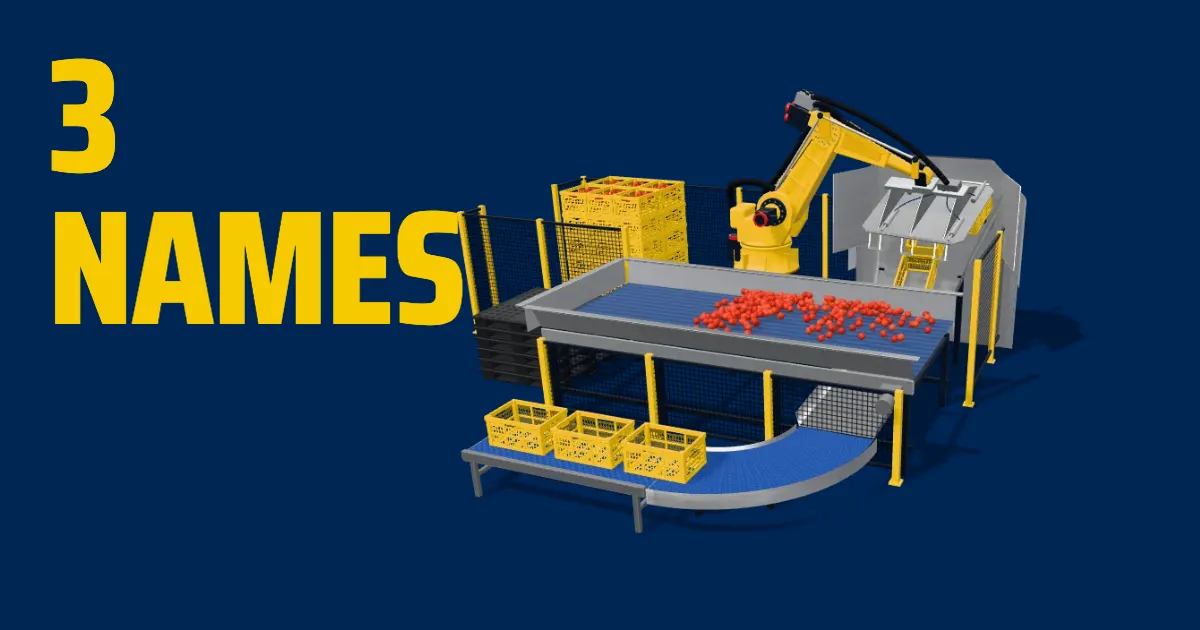
Robot. Agro published one that takes the full layer of plastic crates off the pallet, empties it onto the belt and moves the empties out (Instagram, 2024). Which crates and which weights it handles gets confirmed with yours. For bins the machine is still to be confirmed, so ask about it in the quote.
When does each one work?
| Your case | What is usually enough | Where it falls short |
|---|---|---|
| Mango or lime, moderate volume, short season | Dumping by hand over the tank; CIATEJ, a research center in Jalisco (2016), treats it as valid for mango at moderate volume | Accumulated mass of 10,000 kg per workday at less than 10 m per person (NOM-036, 2018) |
| A forklift is already there and few bins per hour | Rotator | The flow and the height depend on the operator |
| Loose crates and a line with an even pace | Linear or rotary crate tipper | Someone still carries the crates to the belt |
| Plastic crates on pallets, avocado almost all year | Robot that takes the layer, or depalletizer with a dumper | The investment: run it with your days and shifts in the payback calculator |
| Bins all shift at the same point | Continuous bin dumper | Someone still leaves the stack at the infeed |
| Fruit that floats or already gets washed there | Water dumping or tank | Water, chlorine and control add to the cost |
| Dry, delicate fruit, with room for a belt | Dry dumping with a belt or padded ramp | The drop to the belt: measure it before you buy |
| Packing floor with no compressed air and little experience in hydraulics | Electric version, like the one Wyma publishes | Few spec sheets give figures; ask for the cycle in writing |
Speed almost never decides. A 6 t/h line (metric tons per hour) with a 25 kg crate needs 4 crates per minute (Agro Robotics calculation, in how many boxes per minute a packing line needs), and the slowest crate tipper in the table publishes 12.
A crate tipper is rarely the bottleneck of the line: you buy it for the load and for the impact.
When you send your quote request, write all three words and the weight of your crate. In Culiacán, Rochín and Norda write volcador; in Uruapan, Zaizer writes volteadora; the MAF Roda spec sheet says vaciador.
Frequently asked questions
I asked for a volteador and got a quote for a volcador. Is it the same thing?
Can my people keep dumping crates by hand?
If I slow down the dump belt, does the avocado take fewer hits?
Should I get a forklift rotator or a fixed dumper?
Sources
- Industrias Rochín, Recepción (receiving) category, checked Nov 4, 2026 (in Spanish)
- Industrias Rochín, torsion crate dumper, checked Nov 4, 2026 (in Spanish)
- Industrias Rochín, continuous bin dumper, checked Nov 4, 2026 (in Spanish)
- Industrias Rochín, receiving tank, checked Nov 4, 2026 (in Spanish)
- Zaizer, volteadora de cajas (crate tipper), checked Nov 4, 2026 (in Spanish)
- MAF Roda México, vaciador de cajas (crate dumper), checked Nov 4, 2026 (in Spanish)
- MAF Roda México, dry bin dumper, checked Nov 4, 2026 (in Spanish)
- MAF Roda México, crate depalletizer, checked Nov 4, 2026 (in Spanish)
- Aslan Industrial, volteadora de cajas (crate tipper), checked Nov 4, 2026 (in Spanish)
- Norda, rotary bin dumper, checked Nov 4, 2026 (in Spanish)
- Promas, bin and crate tipper, checked Nov 4, 2026 (in Spanish)
- Greefa, vaciadores (dumpers), checked Nov 4, 2026 (in Spanish)
- Wyma, hydraulic bin tipper, checked Nov 4, 2026 (in Spanish)
- Bolzoni, CG-S container tipper, checked Nov 4, 2026 (in Spanish)
- DISPAC, end-of-line volteadora de cajas (box turner), checked Nov 4, 2026 (in Spanish)
- AGHIASA, hydraulic dumpers, checked Nov 4, 2026 (in Spanish)
- Herrera-González and Salazar-García, INIFAP, impacts on Hass avocado on the packing line, 2017 (in Spanish)
- Osuna García, INIFAP, Folleto Técnico 37 on mango packing, December 2019 (in Spanish)
- CIAD with SENASICA, Manual de Buenas Prácticas Agrícolas, 2002 (in Spanish)
- CIATEJ, book on a multipurpose plant for mango, 2016 (in Spanish)
- FAO, Small-scale postharvest handling practices, section 3, 1995
- NOM-036-1-STPS-2018, DOF, Nov 23, 2018 (in Spanish)
- Google, suggestions for volcador de bins in Mexico, test of Nov 4, 2026 (in Spanish)
- Agro Robotics on Instagram, robot for product dumping, Feb 24, 2024 (in Spanish)