
How avocados are packed for export: from the field crate to the sealed truck
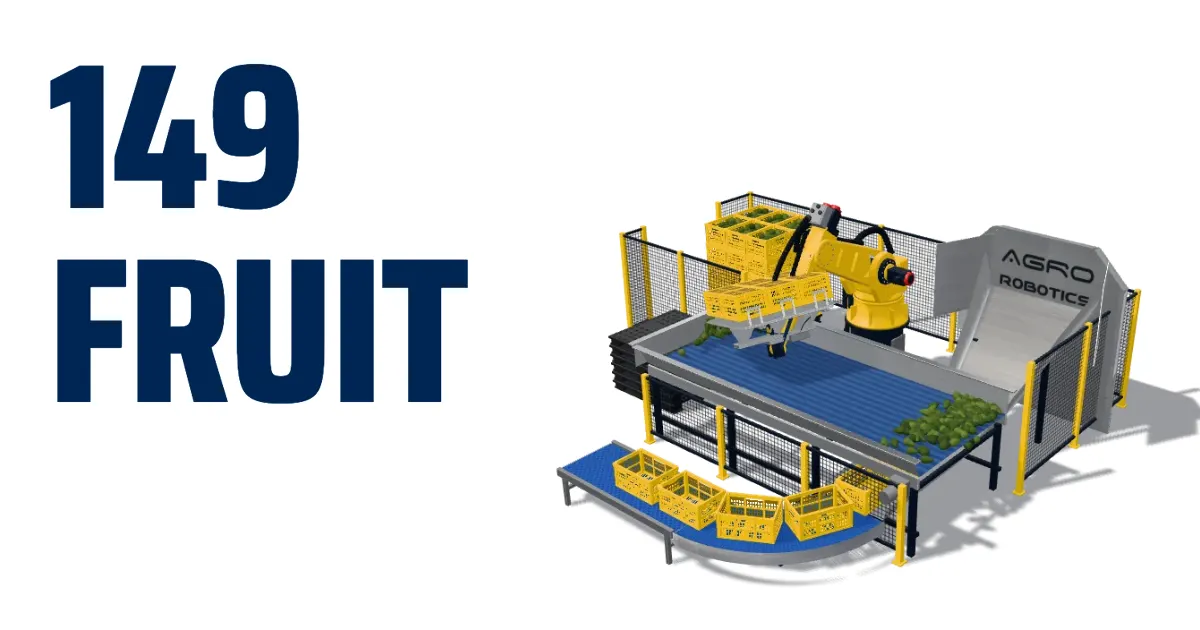
The fruit reaches the packing floor in plastic field crates, a sample is cut per truck, and then it is dumped, sized, labeled fruit by fruit, placed by size and shipped in a sealed refrigerated truck. The heavy lifting sits at the two ends of the line: dumping and stacking.
In Mexico, Hass avocado bound for the United States comes in field crates, goes through a sample of 149 fruit per truck (APHIS and SENASICA Work Plan, 2021), is graded under NMX-FF-016-SCFI-2016 and leaves in boxes of 4 to 11.34 kg. Agro Robotics, a Mexican manufacturer of robots for fruit packing houses, calculates at least 4 people per shift dumping on a 5 t/h line, because of the 10,000 kg cap in NOM-036, Mexico's manual handling standard (DOF, 2018).
In this article
Before a single avocado touches the belt, the inspection unit has already pulled 149 fruit from at least 60 field crates on that truck and cut a minimum of 60 to look for borers (Operational Work Plan of APHIS and SENASICA, Mexico’s agricultural health agency, 2021). How avocados are packed for export is easier to understand if you follow the crate: how much it weighs at each step and who carries it.
This walk-through follows Hass bound for the United States, the destination of 1.08 of the 1.22 million metric tons Mexico exported in 2025 (USDA FAS, March 2026). Only Michoacán and Jalisco are cleared for that market. Agro Robotics makes two machines for the ends of this line, the crate tipper for fruit packing houses and the robotic case packer for fruit; your grader and your sorting stay as you have them.
How avocados are packed for export, stage by stage
| Stage | What moves | Weight | Rule or fact |
|---|---|---|---|
| Harvest in the orchard | Clean plastic crate, marked with the orchard registration | The full crate’s weight, on your receiving scale | Clippers and a hook with a net; the fruit never touches the ground (NMX-FF-016, 2016) |
| Trip to the packing house | One truck per shipment, with its harvest log | Depends on the truck | Same day as harvest; bulk or bags are prohibited (Work Plan, 2021) |
| Receiving | Sample per truck | 149 fruit | 21% dry matter at minimum (NMX-FF-016, 2016) |
| Dumping | Crate by crate, or the full layer with a robot | The crate’s weight, or the layer’s if a robot takes it | White tarp that is changed with every lot (Work Plan, 2021) |
| Rollers, sorting and labeling | Fruit by fruit | From under 85 g to over 265 g (NMX-FF-016, 2016) | Label with the packing house registration on each piece (Work Plan, 2021) |
| Placing | Packed box | 4, 6, 10 or 11.34 kg | A single size, quality and date per box (NMX-FF-016, 2016) |
| Stacking | Pallet | 864 to 907 kg (calculated from the sheet below) | 216 boxes of 4 kg or 80 of 11.3 kg (Michoacán supplier sheet) |
| Shipping | Refrigerated truck or container | 20 to 22 pallets in a 40-foot container (same sheet) | Seal and phytosanitary certificate (Work Plan, 2021) |
Read the weight column from top to bottom. It starts at 25 kg, drops to grams mid-line and climbs to almost a metric ton on the pallet. Backs wear out at the first station and at the last; in the middle the eyes do the work.
What gets checked when the truck reaches the packing house?
There are two checks, each with its own rules.
The first looks for pests. Each truck is one shipment, it arrives with its harvest log, and the inspection unit or APHIS can refuse entry to the lot on a paperwork review alone. The sample is taken before sorting: 2 to 3 fruit per crate until there are 149, with every lot on the truck represented (Operational Work Plan, 2021).
The second covers maturity and quality. NMX-FF-016-SCFI-2016, Mexico’s standard for Hass avocado, requires at least 21% dry matter in each fruit, with 5 fruit per lot dried in a microwave; if one comes in between 19% and 21% the test is repeated with 10, and one fruit under 19% on the first test rejects the lot. The 2021 work plan with USDA requires the same 21%. Separately, a cut that shows black fiber, a vinegary smell or a bitter taste knocks the lot out in any grade.
One detail of the building weighs on any construction plan. Every opening to the outside carries mesh of 1.6 mm at most, with double doors or an air curtain, and at dumping a white tarp is authorized so the inspector can see leaves and branches (Operational Work Plan, 2021). A new cell has to respect that enclosure: the pallet passage cannot open a gap in it either.
Where is the heavy work on an avocado line?
First, at dumping. In February 2024 Agro published a 25 kg field crate, right at the limit that NOM-036-1-STPS-2018, Mexico’s manual handling standard, sets for men aged 18 to 45, and 5 kg above the 20 kg limit for women of that age (DOF, Mexico’s official federal gazette, 2018).
The standard also caps accumulated mass: 10,000 kg per 8-hour workday if the load is carried less than 10 meters. On a line of 5 t/h (metric tons per hour), 5,000 kg times 8 hours divided by 10,000 kg gives at least 4 people per shift dumping, and each one moves 400 crates of 25 kg (Agro Robotics calculation, at a steady pace). If nobody on your packing floor has added up the kilos per person and per shift, that is the first number you are missing.
Then, at stacking. A pallet of 80 boxes of 11.34 kg adds up to 907 kg, so the same 10,000 kg is reached with 11 pallets per person (Agro Robotics calculation), and the top layers go up above shoulder height.
In the middle, NOM-036 barely applies: it leaves out loads under 3 kg, and an avocado weighs grams. The breakdown by age and sex is in how NOM-036 applies in fruit packing houses.
Agro’s fruit crate tipper, which in Mexico you will hear called volteador or vaciador, takes the full layer of plastic crates off the pallet and empties it onto the belt. It takes the load out of people’s hands and leaves those people for sorting and inspection, where the line needs eyes.
Four to six minutes between the hopper and the box
INIFAP, Mexico’s national agricultural research institute, measured this stretch in 4 certified packing houses in September 2012, with results published in 2017: depending on the plant, the fruit takes from just under 4 to about 6 minutes to pass through dumping, rollers and brushes, manual sorting with singulator and labeling, and the drop into the hopper. On that trip it takes 37 to 43 impacts, and the hardest ones happen at dumping. The full numbers are in avocado bruising during packing, and to check your own drops you have the fruit drop height tool.
Before the box, each piece must be free of twigs and leaves, with its stem at 12 mm or less, and carry a label with the packing house registration number and the statement of origin. In a clamshell or a mesh bag, the label may go on the outside only (Operational Work Plan, 2021).
What box does export avocado ship in?
No standard sets the dimensions. NMX-FF-016 requires strength and ventilation and leaves the dimensions to whatever the market asks for; the work plan accepts a new, clean box, a bulk bin or a reusable plastic crate, marked with grower, packing house and exporter.
| Box | How the fruit goes | Where it shows up |
|---|---|---|
| 4 kg | Sizes 12 to 26 | Codex basis for Europe, according to NMX-FF-016 (2016); Michoacán supplier sheet |
| 6 kg | Varies by size | Same sheet |
| 10 kg | Sizes 26 to 32 at a Colombian exporter | 2018 sheet; in Mexico we saw it only in buyer requests (Cosmos, 2026) |
| 11.34 kg (25 lb) | Two layers, sizes 32 to 84 | USDA AMS, November 3, 2026; Avocados From Mexico, 2025 |
Each box must hold a single origin, variety, packing date, quality and size, and show on the outside the name and address, “Producido en México” (Produced in Mexico), grade, size and date (NMX-FF-016, 2016). That is why the line ends in several outlets and why placing by hand is so repetitive. The chart of pieces and grams is in avocado sizes.
Agro’s robotic case packer, which you will also hear called encajillador, works at that outlet and is quoted with your fruit. A case packing robot serves one outlet of the line, and it pays to choose the one that ties up the most people.
Stacking, cold and seal: the last steps before shipping
The pallet wood must comply with ISPM 15 (NIMF 15 in Spanish), and the shipment is palletized once it has passed inspection as pest free. Before loading, the vehicle is checked: closed, refrigerated and swept. On departure it carries a seal and a phytosanitary certificate, and the seal is changed only if another approved packing house completes the load, with an officer present (Operational Work Plan, 2021).
The Michoacán supplier’s sheet (accessed November 4, 2026) gives 216 boxes of 4 kg or 80 of 11.3 kg per pallet, 3 to 7 °C and 20 to 22 pallets per 40-foot container. If you want the count with the dimensions of your own box, it is in how many fruit boxes go on a pallet, and this station is the one for fruit box palletizing.
Since October 1, 2026 there is one more document: Mexico’s labor certificate for agricultural exports (Certificado Laboral para la Agroexportación), which the exporter processes in VELAGRO and which is declared on the customs entry, the pedimento (the STPS, Mexico’s labor ministry, Bulletin 112/26). We explain it in labor certificate for avocado exports.
The 1.22 million metric tons of 2025 equal about 108 million boxes of 25 lb, an Agro Robotics calculation with USDA FAS data from March 2026.
Frequently asked questions
How are avocados packed for export to the United States?
How much does a box of export avocado weigh?
How many of my avocados get cut open in the truck inspection?
Can I bring avocado in bulk or in sacks from the orchard?
How many people do I need to dump crates by hand?
Sources
- APHIS and SENASICA, Operational Work Plan for Hass avocado from Mexico to the United States, 2021
- Secretaría de Economía, NMX-FF-016-SCFI-2016, Hass avocado, specifications (in Spanish)
- STPS, NOM-036-1-STPS-2018, manual handling of loads, DOF, Nov 23, 2018 (in Spanish)
- Herrera-González and Salazar-García, INIFAP, Revista Mexicana de Ciencias Agrícolas, 2017 (in Spanish)
- USDA FAS, Avocado Annual, Mexico, MX2026-0019, Mar 12, 2026
- USDA AMS, Los Angeles Terminal Market Fruit Prices, Nov 3, 2026 (the link shows the current day's report)
- Avocados From Mexico, Avocado Size Chart, 2025
- Hass avocado spec sheet from a supplier in Michoacán, on Mi Tiendita Virtual of the Mexico City government, accessed Nov 4, 2026 (in Spanish)
- Hass avocado product sheet from a Colombian exporter, 2018, on ConnectAmericas
- Cosmos directory, requests for avocado boxes, accessed Nov 4, 2026 (in Spanish)
- STPS, Bulletin 112/26, Certificado Laboral para la Agroexportación, Oct 1, 2026 (in Spanish)