
Avocado bruising during packing: why it turns black inside
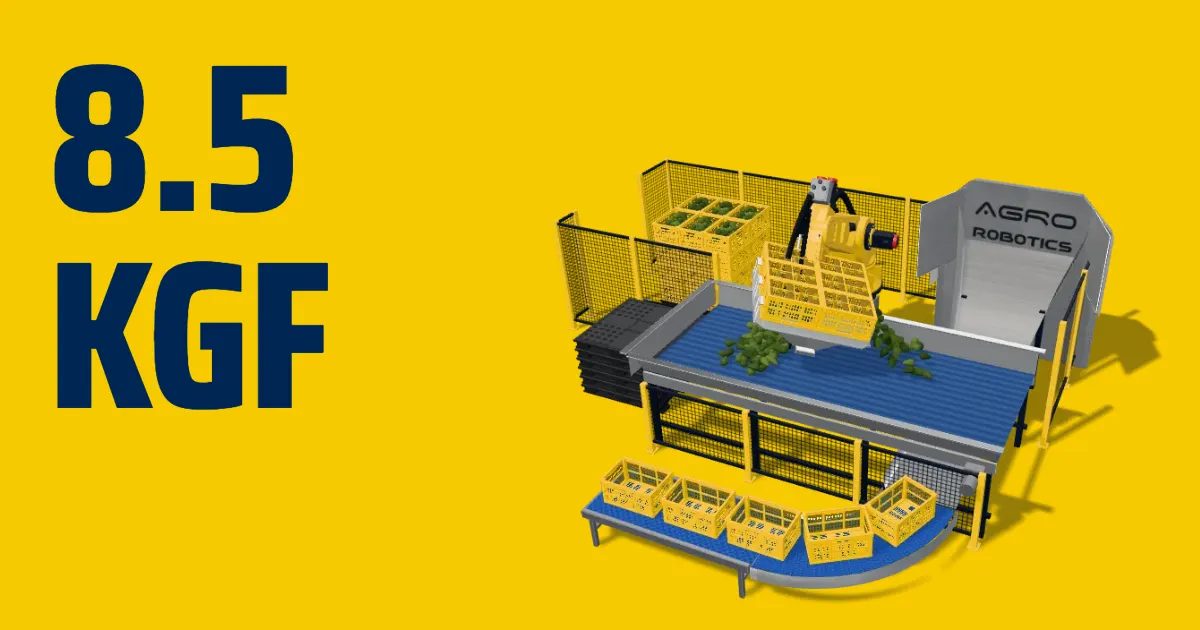
Because the impact damages the flesh without marking the skin, and it shows only once the avocado ripens. In 2012 INIFAP measured the hardest impacts at dumping, and slowing the belt did not reduce them because the drop height stays the same.
INIFAP, Mexico's national agricultural research institute, published in 2017 a 2012 measurement in 4 export Hass avocado packing houses in Mexico: the most intense impacts happened at dumping, with an average maximum of 8.5 kgf, and slowing the belt did not reduce them. The internal damage shows only at eating ripeness. Agro Robotics suggests measuring drop height, surface and days in cold storage on each line.
In this article
“Black fiber, a vinegary smell or a bitter taste.” If the cut sample turns up any one of those three, NMX-FF-016-SCFI-2016, Mexico’s standard for Hass avocado, rejects the lot in any grade. Avocado bruising during packing behaves differently: the avocado leaves the fruit packing house with clean skin, and the darkening appears only once it ripens, far from your dump belt by then (INIFAP, Mexico’s national agricultural research institute, 2017).
The Mexican measurement we found on this has to be read with its date. It was taken in September 2012, in 4 certified packing houses that were 10% of those operating then, and it was published in 2017 (Herrera-González and Salazar-García, Revista Mexicana de Ciencias Agrícolas). Your line today may come out better or worse. The method still holds, and the part that concerns the machine is in the fruit crate dumping guide.
Avocado bruising during packing: what INIFAP measured
They ran a wireless avocado-shaped sensor with a three-axis accelerometer through each line 18 times. The full run took from just under 4 to about 6 minutes, and the number of impacts barely changed between plants. One kgf is one kilogram-force, 9.81 newtons.
| Packing house | Impacts per run | Average maximum impact | Average intensity |
|---|---|---|---|
| 1 | 42.7 | 9.9 kgf | 1.6 kgf |
| 2 | 42.4 | 8.1 kgf | 1.3 kgf |
| 3 | 42.1 | 7.4 kgf | 1.1 kgf |
| 4 | 37.3 | 5.8 kgf | 1.0 kgf |
All four had the same level of technology, according to the paper. If one line hits almost twice as hard as another at the same level of technology, some impacts can be removed by adjusting, before you buy anything.
Where on the line does the avocado get hit the most?
The run was split into four stages, with 10 sensor passes in each (INIFAP, 2017):
| Stage | Impacts | Average maximum impact | Average intensity |
|---|---|---|---|
| Dumping | 6.1 | 8.5 kgf | 2.9 kgf |
| Rollers and brushes | 45.6 | 6.7 kgf | 1.0 kgf |
| Manual sorting, singulator and labeling | 14.9 | 6.6 kgf | 1.9 kgf |
| Drop into the hopper and hopper | 7.6 | 6.0 kgf | 1.9 kgf |
The two columns have to be read together. Rollers and brushes give many small impacts; dumping gives a few hard ones. The paper warns that a high impact can happen at any stage, and it describes the delicate point: the crate tippers drop the fruit onto a 0.4 m padded surface that carries it to a belt of plastic or metal rollers, and the collision with those rollers is the one that hits hard.
Does slowing the dump belt reduce the impacts?
They tested the belt at 24, 40 and 50 Hz. The maximum impact stayed between 6.3 and 8.6 kgf and the average between 2.4 and 3.9 kgf, with no statistical difference (INIFAP, 2017). A slower belt drops the fruit from the same place.
On the number of impacts, the paper shifts a little: it reports from 6.1 at the high speed to 3.5 at the low one and treats them as similar, in the discussion it says that slowing down reduces the number, and in the conclusions that it reduces neither number nor intensity. The firm finding is the intensity, and besides, you would be taking pace away from the whole line.
Which surface and which height damage the flesh?
They dropped 20 fruit per treatment and waited for eating ripeness at room temperature, with fruit at 32% to 40% dry matter (INIFAP, 2017):
| Surface | Heights tested | Result in the flesh |
|---|---|---|
| Wood board | 0.6 to 1.1 m | No damage |
| Wood with “dulona” | 0.5 to 1.1 m | No damage |
| Smooth metal | 0.3 and 0.5 m | No damage |
| Smooth metal | 0.7 and 0.9 m | The highest values in the study |
| Metal with “dulona” | 0.3 to 0.6 m | More than 5% of fruit damaged |
| Other fruit | 0.2 to 0.8 m | More than 5% of fruit damaged |
| PVC tubes | 0.2 to 0.8 m | More than 5% of fruit damaged |
Two rows stand out. Fruit against fruit and PVC tube already caused damage from 20 cm, and metal with “dulona”, as the paper calls it, came out worse than smooth metal at low height, and the text does not explain why. Test your own material before you trust the lining.
In Australia, Perkins and coauthors recommend drops of less than 15 cm for hard fruit and less than 10 cm once it starts to soften, and they warn that 30 cm can lead to rot at ripening (Talking Avocados, January 2018). That target is stricter than what INIFAP saw on wood or on low metal. Between one source and the other, keep the more cautious target until you have your own test. To measure yours there is the fruit drop height tool.
Why the damage shows only at eating ripeness
No treatment damaged the skin. The damage was darkening and air cavities in the flesh, and it became visible when the fruit ripened (INIFAP, 2017). Whoever checks the box as it leaves the packing floor has no way to see it.
Cold counts. With 14 days at 5 °C, the differences between treatments were not significant. With 28 days, almost all of them showed darkening and cavities, with up to 0.65 on a scale where 0.5 is 5% of the flesh and 1 is 10%, and most treatments went past 10% mass loss at eating ripeness. If your fruit travels for weeks, today’s impact gets charged at the end of the trip.
It also helps to separate what you see when you cut the fruit open. INIFAP left flesh discoloration, vascular browning and stem-end rot out of its count, because they cite that those kinds of damage do not come from impacts. The black fiber in the NMX is looked for when the lot sample is cut; INIFAP’s darkening with cavities was evaluated on ripe fruit. Note on your sheet which one you saw, because each is investigated somewhere else: line, orchard or cold chain.
What to measure on your avocado line
A tape measure, a sensor and a box of fruit are enough to start:
- Height of each drop. Dumping, roller infeed, singulator, drop into the hopper, drop into the box.
- Material it lands on. Metal, PVC, wood or padding, and whether it is already worn.
- Impact reading. If you can get a sensor, repeat what INIFAP did: 10 passes per stage, with maximum impact and average intensity.
- Cut test. 20 fruit per point, ripened at about 22 °C and cut in half, against 20 that did not go through that point.
- Days in cold storage per shipment. Run the same test with the length of your trip.
- Type of defect. Dark spot with a cavity, dark fiber or rot at the base, each on its own line.
Agro declares gentle metering for its fruit crate tipper, which in Mexico is also called vaciador (2021 presentation), and does not publish an impact measurement. If you want that figure, ask for it with a sensor and with your fruit. The full run of the line is in how avocados are packed for export.
Ask any supplier for the maximum impact reading at the dumping point, with your fruit and with a sensor. The public reference is the 5.8 to 9.9 kgf that INIFAP measured in 2012.
Frequently asked questions
Why does my avocado look fine outside and come out black inside?
From what height does a falling avocado get damaged?
Does cold make a bruised avocado worse?
Is that INIFAP study still useful?
Sources
- Herrera-González and Salazar-García, INIFAP, Impactos al fruto de aguacate Hass en la línea de empacado, Revista Mexicana de Ciencias Agrícolas, 2017 (in Spanish)
- Secretaría de Economía, NMX-FF-016-SCFI-2016, Hass avocado, specifications (in Spanish)
- Perkins, Mazhar, Joyce, Ainsworth, Coates and Hofman, Talking Avocados, Avocados Australia, Jan 31, 2018